A Gen Z perspective from inside the world of human capital research
I’m Gen Z, and I spend my workdays immersed in the world of HR and workplace technology. One thing you notice quickly from that vantage point: everyone is talking about what young employees want from AI at work, and a lot of the loudest assumptions come from people who aren’t young employees.
So here’s what it actually looks like from my side.
And look, the hype isn’t wrong. AI is changing how companies hire, train, and manage people. But a lot of companies are designing these tools around a stereotype of young employees, and the stereotype doesn’t match reality.
Myth #1: Slapping “AI-powered” on a tool will win young employees over
I’ll admit it: AI genuinely impresses me. I’ve watched it draft, translate, summarize, and reason in ways that would have sounded like science fiction a few years ago. Which is exactly why a mediocre “AI-powered” HR tool doesn’t.
Here’s the difference. Older generations often experience workplace AI as a leap, a before and after. For us, there was no before. We grew up alongside these tools, watched them improve month by month, and we know firsthand what great AI feels like. So when an HR platform proudly announces its “AI-powered experience,” our reaction isn’t wonder or dismissal. It’s evaluation: Is this actually good, or is it a chatbot stapled to a form?
The bar isn’t “does it use AI.” The bar is “does it live up to what I know AI can do.” A clunky AI assistant is worse than no AI assistant, because it signals that the organization adopted the technology for the press release, not the people. Being impressed by the technology and unimpressed by a lazy implementation of it aren’t contradictory. They’re the same standard.
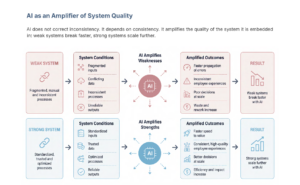
Our own research backs this up. Brandon Hall Group’s new report, The AI-Enabled HR Operating Model: From Programs to Products, calls this the “illusion of progress.” A chatbot answers questions, a dashboard looks impressive, and from a distance it seems like transformation is happening. But when nothing underneath has changed, usage declines and trust erodes. The report puts it simply: AI amplifies whatever system it is placed into. Weak systems break faster. Strong systems scale further.
Myth #2: We want AI to replace human interaction
This one drives me a little crazy. Because Gen Z is “digital native,” the assumption becomes that we’d prefer a bot for everything: screening, onboarding, feedback, career conversations.
The opposite is closer to the truth. When something is high-stakes and personal, like a promotion conversation, a performance review, or a question about whether I belong here, I want a human. What I want AI to do is clear the path to that human: handle the scheduling, surface the data, kill the paperwork. The best use of AI in HR is to automate the administrative sludge so that the human moments get more time, not less.
If your AI strategy reduces the number of real conversations young employees have with real leaders, you’ve automated the wrong thing.
Myth #3: AI transparency doesn’t matter as long as it works
Young employees are entering a job market where AI touches everything. Job seekers are using AI before they ever land on a career site, and employers are using AI to screen them right back. We know we’re being evaluated by algorithms. What we don’t always know is how.
Here’s the paradox organizations miss: the generation most comfortable using AI is often the most skeptical of AI being used on them. We’ve grown up watching algorithms make weird, biased, or opaque decisions. So when HR deploys AI in hiring or performance and can’t explain how it works, trust doesn’t just dip. It never forms in the first place.
Responsible AI governance isn’t a compliance checkbox for us. It’s the whole ballgame. Tell us what the model looks at. Tell us what it can’t decide on its own. Tell us who’s accountable when it gets something wrong.
Myth #4: Gen Z doesn’t need AI skills training because they were born with it
Fluency with consumer AI is not the same thing as workplace AI capability. I can prompt a chatbot into next week, but knowing when to trust an output, how to verify it, where the ethical lines sit, and how to fold AI into an actual business process? That’s a skill set, and nobody is born with it. Our research draws exactly this line, distinguishing AI literacy from operational AI capability: awareness generates enthusiasm, but adoption only sticks when people apply AI inside real workflows tied to real outcomes.
Ask any HR leader and they’ll admit it: most organizations still can’t clearly answer what skills they have, what skills they need, or who owns closing the gap. Meanwhile, AI literacy keeps showing up at the top of every “most urgent skills” list. If organizations assume their youngest employees will just figure it out, they’re skipping the generation with the most runway to build on.
Invest in us early. We’ll be using these systems longer than anyone else in the building.
What getting it right actually looks like
The organizations that are pulling ahead aren’t the ones with the most AI. They’re the ones that treat AI adoption as a progression: moving deliberately from experimentation toward systems that genuinely amplify people. For young employees, that progression looks like this:
Treat us as evaluators, not audiences. Let us stress-test the tools before you roll them out, because we will find the weak spots in about four minutes.
Automate the sludge, protect the humans. Use AI to buy back time for mentorship, feedback, and career conversations, the things that actually keep us from leaving.
Show your work. Explainable, governed AI earns trust from a generation that has seen exactly what ungoverned algorithms do.
Build our AI capability on purpose. Don’t confuse our comfort with competence. Train us like the long-term AI workforce we’re going to be.
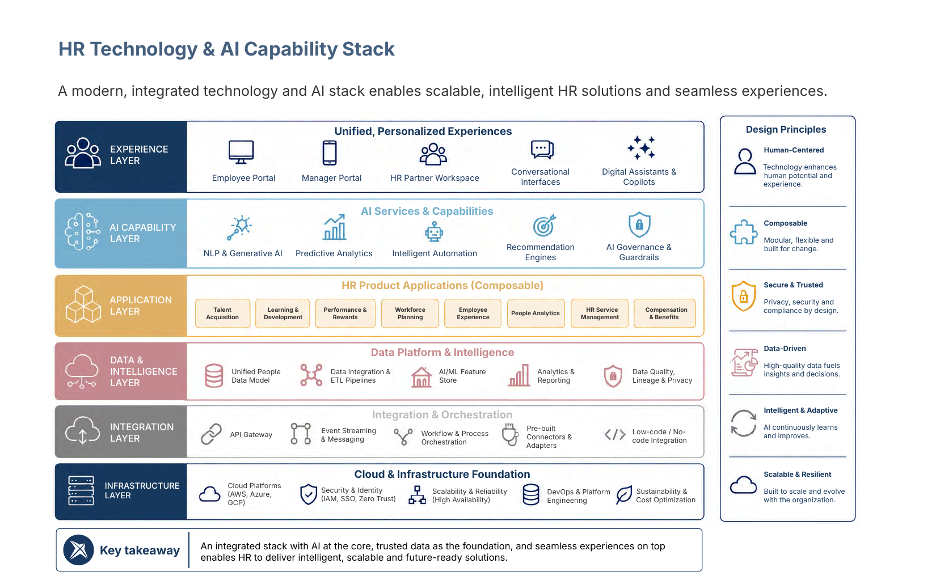
There’s a graphic in the report that sums all of this up better than I could. HR technology is a stack. Employees only ever touch the experience layer at the very top: the portals, the assistants, the copilots. But whether that layer feels great or terrible depends on everything underneath it, from the data and integrations at the bottom to the governance in the middle. Employees experience the top of the stack. Trust is built at the bottom.
AI in HR isn’t a Gen Z story or a boomer story. Five generations are navigating this at once, each from a different starting point. But if there’s one thing my generation can offer, it’s this: we’ve never known a world without algorithms, which means we’ve never had the luxury of trusting them blindly. Build these tools for people who ask hard questions, and you’ll build something every generation can trust.