Just over a year ago, I wrote about Darwinbox becoming the first HCM platform to launch a Model Context Protocol (MCP) Server, a move that demonstrated the company was thinking differently about the future of enterprise AI. At a time when most HR technology vendors were introducing copilots and conversational assistants, Darwinbox was investing in the underlying architecture that would allow AI agents to securely understand and interact with enterprise HR systems.
At the time, the announcement felt more like a glimpse into where the market was headed than a feature launch.
With the introduction of Cortex, which Darwinbox describes as its new AI-native HCM platform, the company is showing what that architectural foundation was designed to support.
More importantly, the announcement reflects something I’ve started noticing across the HR technology market. Over the past year, the conversation has gradually shifted. Early AI briefings centered on copilots, chat interfaces, and productivity. Increasingly, vendors are talking about context, orchestration, governance, and how AI fits into the way organizations actually operate.
Darwinbox is one of the clearest examples of that evolution.
The First Phase of Enterprise AI Focused on Productivity
Over the past two years, the HR technology market has experienced an explosion of AI capabilities.
Nearly every major platform introduced copilots, conversational search, automated content generation, meeting summaries, workflow recommendations, and natural language interfaces. These innovations have helped HR professionals complete routine work faster and reduced much of the administrative effort that consumes their day.
As organizations become more comfortable with AI, expectations are changing. HR leaders are asking different questions. Instead of simply reducing administrative effort, they want AI that understands how their organization operates, recognizes emerging workforce issues before they become business problems, and supports decisions across the enterprise.
While traditional HCM competitors such as Workday, SAP SuccessFactors, Oracle, UKG, and Dayforce continue to advance their AI strategies, the competitive landscape is also expanding. HR leaders increasingly compare the experience of enterprise HCM platforms with AI ecosystems from Microsoft, Salesforce, ServiceNow, and other enterprise software providers that are redefining how work gets done. The expectation is no longer just intelligent HR software. It’s intelligent enterprise software.
That raises the bar for every HCM provider, including Darwinbox.
Cortex Builds on the Foundation Darwinbox Started Last Year
During the analyst briefing, Darwinbox spent surprisingly little time talking about the number of AI agents it has built.
Instead, much of the discussion centered on organizational context.
Darwinbox organized Cortex around four architectural foundations: the Signal Layer, which continuously identifies patterns across workforce data; the Context Graph, which maps the organization’s people, policies, workflows, and decisions; the Cortex Agent Platform, which connects intelligence, workflows, integrations, and governance; and the Experience Layer, which brings interactive experiences into Microsoft Teams, Copilot, Slack, Glean, and other tools.
The architecture is where this announcement became interesting to me.
Rather than competing on the number of AI capabilities, Darwinbox is making the case that enterprise AI becomes valuable only when it understands the organization it is operating within. Context, governance, organizational relationships, business rules, and historical interactions become the foundation for intelligent decision-making rather than simply retrieving information.
The company also challenged the industry’s growing focus on launching ever-larger collections of AI agents. Instead of measuring innovation by the number of agents available, Darwinbox argued that enterprise value comes from intelligence capable of dynamically orchestrating work based on organizational context instead of relying solely on predefined workflows.
Whether organizations ultimately agree with that position will be determined by customer outcomes, but it represents one of the more thoughtful architectural conversations I’ve heard in an HR technology briefing this year.
Cortex is launching with a select group of design partners, including Visteon and Transcarent, while Darwinbox works with ecosystem partners such as Microsoft, Slack, and Glean. That early access approach gives the company an opportunity to test the architecture against complex workforce needs before broader adoption.
The Conversation Is Shifting from AI Features to AI Progression
At Brandon Hall Group, we’ve been examining this evolution through our AI Progression Model, which looks at how organizations mature from experimenting with AI to embedding intelligence throughout the enterprise.
Early stages of AI adoption naturally focus on individual productivity. Organizations introduce AI assistants, automate repetitive work, and help employees retrieve information more efficiently.
As maturity increases, AI becomes connected across enterprise systems. It understands business context. It recognizes patterns across functions. It begins supporting organizational decisions instead of simply completing isolated tasks.
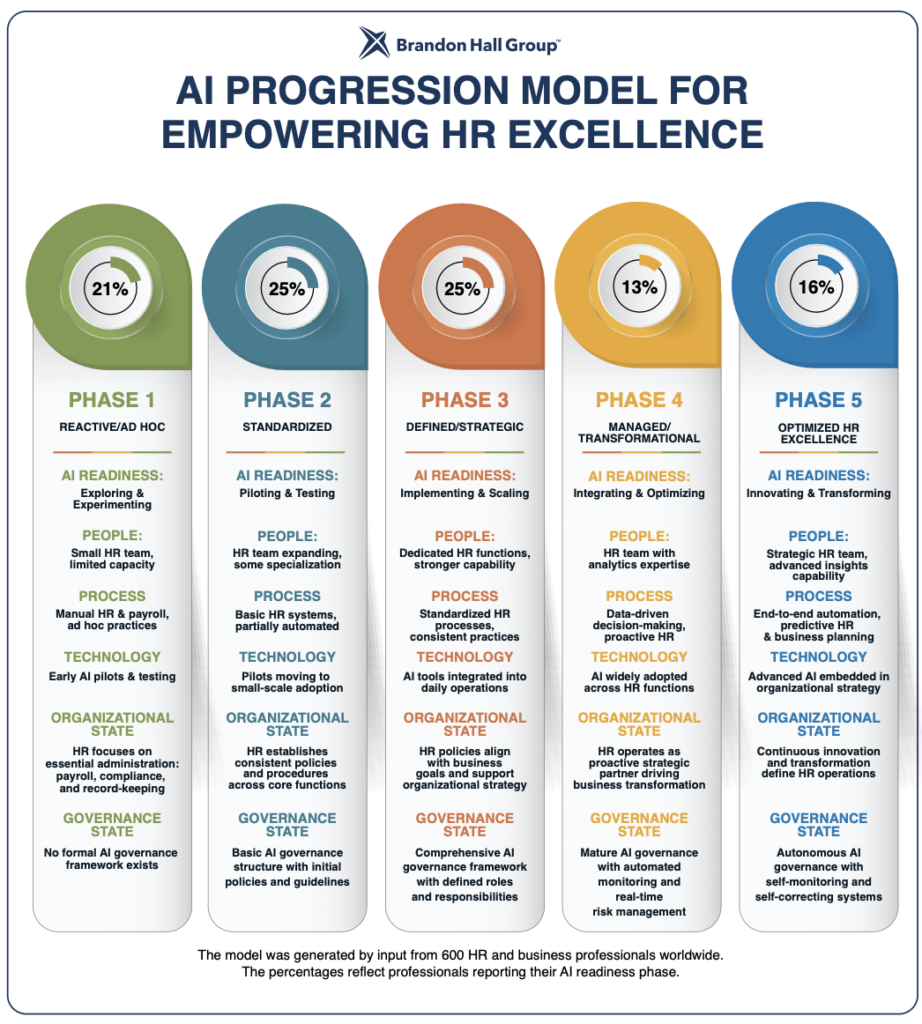
A year ago, introducing AI into an HCM platform was enough to stand out. Today, virtually every major provider has an AI strategy. The conversation is naturally shifting toward what those capabilities actually enable and whether they improve business decisions, accelerate execution, or create a better employee experience.
That is where Darwinbox appears to be placing its bet.
Technology Evolves. Operating Models Have to Evolve With It.
As AI becomes embedded across workforce planning, talent acquisition, learning, employee support, manager enablement, and workforce intelligence, it starts influencing much more than technology. Governance changes. Decision-making changes. Teams collaborate differently. The operating model that worked before AI may not be the one that allows organizations to capture its full value.
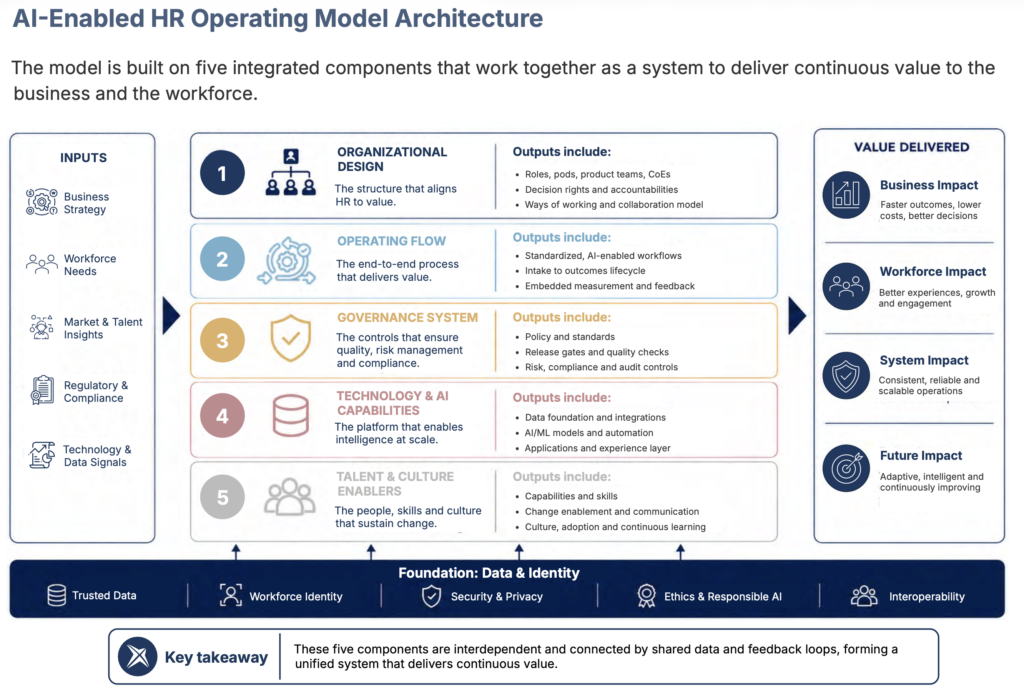
That thinking led Brandon Hall Group to develop our AI-Enabled HR Operating Model, which explores how HR organizations must evolve as AI becomes part of everyday work.
Rather than viewing AI as another technology implementation, the model examines governance, product-based service delivery, cross-functional collaboration, continuous improvement, and workforce capabilities that enable HR to operate effectively in an AI-enabled environment.
I’ve often said that technology rarely transforms organizations by itself.
The way work is organized, governed, and executed ultimately determines whether new technology delivers meaningful business value.
Our Perspective
What I find most interesting about Cortex isn’t the technology itself.
It’s that the conversation is moving beyond features and toward operating principles.
Vendors are beginning to ask how AI fits into the way work is organized instead of simply where AI can be added. That is the same conversation we’ve been having at Brandon Hall Group through both our AI Progression Model, which helps organizations understand their AI maturity, and our AI-Enabled HR Operating Model, which helps HR leaders prepare for what comes next.
One year ago, Darwinbox demonstrated how enterprise AI could securely connect to HR systems through Model Context Protocol. Cortex shows that the MCP announcement was not an isolated feature launch, but part of a broader architectural direction. The company is now exploring what those connections can become when AI understands organizational context and can coordinate work across the enterprise.
Whether Cortex ultimately becomes a market-defining platform will depend on customer adoption and measurable business outcomes.
Looking across the market, I believe we’re entering the next phase of enterprise AI. The first phase introduced intelligence into software. The next phase is about embedding AI into the operating model itself, reshaping how work is organized, decisions are made, and HR delivers value across the enterprise.