Organizational AI investment increased significantly in 2024 and 2025. Budgets grew, vendors expanded and pilot programs launched. However, many companies saw only modest results: adoption stalled, productivity gains were limited and leaders quietly reduced expectations.
The gap between AI’s potential and actual performance is well-documented. Brandon Hall Group™ research shows digital transformation frequently fails due to insufficient human capability, not technology. Without a capability infrastructure, employees do not change their work habits. Without manager-readiness programs, leadership behaviors remain unchanged. Organizations that neglect readiness infrastructure typically see poor returns on AI investments, showing that success with AI requires investing in both technology and human and managerial readiness.
Where AI Initiatives Actually Stall
Common explanations for AI adoption failure focus on change management: poor communication, one-time training programs and leaders who back initiatives but do not model desired behaviors. While these factors matter, they are symptoms of a more profound structural issue.
Brandon Hall Group™’s Learning and Development Progression Model measures L&D across four phases. When it comes to AI adoption, 39% of organizations lack foundational enablement infrastructure: no personalized pathways, no analytics to identify capability gaps and no way to scale tool access into skills.
The 44% of organizations who fall into Phase 3 (Defined/Strategic) face a different challenge. They have the structure to launch AI initiatives but often mistake deployment for adoption, viewing AI as a technology rollout instead of a capability-building effort that requires speed to sustained adoption. This approach leads to stagnant adoption rates. Only at Phase 4 (Optimized) do organizations achieve widespread AI adoption throughout L&D, supported by analytics expertise, data-driven decisions and forward-thinking learning infrastructure. Only 17% of organizations have reached this level.
NovoEd, a Diamond-level Brandon Hall Group™ Smartchoice Solution Provider, is designed to provide continuous, applied development infrastructure that helps organizations progress to Phase 4 instead of stalling at deployment.
From Program Deployment to System-Based Development
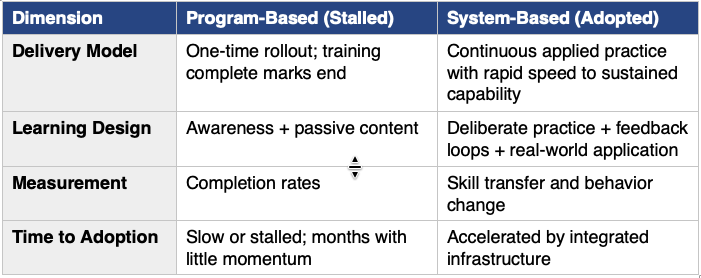
A key differentiator in award-winning AI adoption is the shift from thinking about AI rollouts as discrete programs to building it into continuous capability development systems. Here’s how these approaches differ:
What Award-Winning AI Adoption Actually Looks Like
Brandon Hall Group™ analysis of award-winning AI in Learning programs illustrates what effective AI adoption looks like and what distinguishes it from standard rollouts.
In these organizations, AI role-play and simulations appeared in 54% of case studies, AI content generation in 46%, as well as AI-driven personalized learning in 42%. The key differentiator was not tool sophistication, but the learning experiences built around them. Award-winning organizations combined AI capability with deliberate practice, using simulated environments, collaborative cohorts and structured feedback instead of demonstrations or passive modules.
An analysis of Excellence Award winners in AI for Business Impact demonstrates several findings: All winners implemented AI-driven personalized learning paths and real-time analytics as core infrastructure; Microlearning was integrated into workflows appeared in nearly all instances; Just-in-time performance support at the point of need was present fourth-fifths of the time. The unifying principle is application: learning is designed for direct transfer into practice, with AI accelerating and measuring that transfer. These experiences where peer collaboration, discussion and reflection are vital to learning. Teamwork spaces, threaded feedback and practice assignments in various media let learners interact with AI tools in realistic work conditions from the start, not for the first time after program completion.
Manager Readiness as the Choke Point
AI adoption programs do not succeed if managers lack understanding or trust in AI. Workforce resistance frequently stems from unprepared managers. This shows that manager readiness is the main point where most adoption efforts fail. Addressing this is essential for real change.
Managers need their own applied development experience, including opportunities to practice AI-enabled coaching before delivering it. NovoEd’s Mentor+ supports this need. Structured conversation frameworks and automatic action tracking provide managers with visibility into mentoring progress and outcomes. Automatic reminders keep development relationships active between sessions. NovoAI, NovoEd’s AI suite, offers Discussion Insights that synthesize coaching themes and highlight moments that need deeper guidance, providing real-time direction without requiring L&D to monitor every exchange manually.
Applied Learning as the Enablement Infrastructure
The ongoing challenge with AI adoption is not insufficient training content, but the lack of transfer to actual work behavior. Employees may complete training but fail to change their work habits. The key takeaway: effective enablement requires application and practice, not simply knowledge acquisition.
NovoEd’s Practice+ boosts the application layer beyond most platforms. Video practice rooms and real-time scenarios allow employees to rehearse AI-enabled workflows before high-stakes situations. NovoAI’s Practice Insights analyzes video and audio submissions for rate of speech, filler words and key terms, delivering targeted, actionable feedback instead of generic completion records. These insights are downloadable, giving L&D leaders a stronger evidence base for skill acquisition than course completion rates alone.
For organizations with global teams, NovoAI’s AI Translation eliminates a frequent barrier between scale and quality. Learners can translate lesson content and peer activity instantly within the same course, enabling cohort-based AI capability building for multilingual workforces without recreating programs for each language market.
Learn+, Practice+, Mentor+ and NovoAI demonstrate the principle found in award-winning research: skill acquisition must be combined with applied practice and feedback, with AI lowering administrative overhead through purposeful design and integration that promote meaningful behavior change.
Naming the Problem: The Readiness Trap
The Readiness Trap occurs when organizations invest in AI technology before developing the human capability to use it, then attribute adoption failure to technology, employees, or change management. The real issue is the lack of applied learning infrastructure. These organizations do not need different tools; they need a new approach to enablement that pairs skill acquisition with real work practice, not simply awareness or access.
The vast majority of organizations that fall below Phase 4 on Brandon Hall Group™’s L&D Progression Model need more than improved AI adoption; they require a human-centered learning infrastructure with systems designed for speed to sustained capability development. Closing the gap begins with building this base for effective capability transfer.