I have spent a lot of time over the past several years studying skills.
At Brandon Hall Group, we have researched skills-based organizations, built frameworks around skills architecture, talked with technology providers and, most importantly, advised organizations trying to turn the idea of skills into something that actually changes how they hire, develop, deploy and plan their workforce.
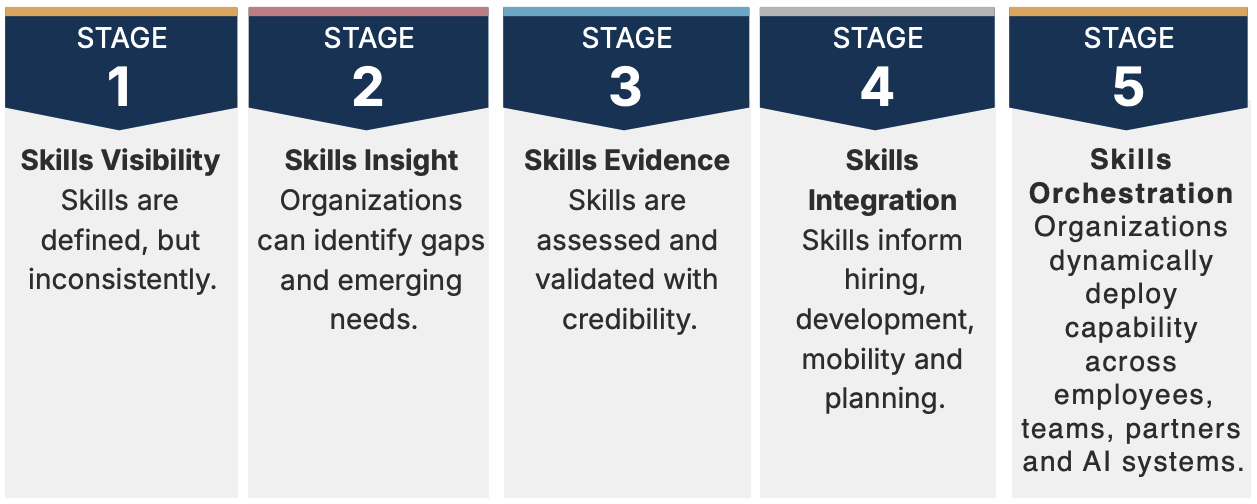
Our recent research, Skills, Work and Talent: Why Skills Architecture Is Becoming the New Operating Logic for the Enterprise, looks at that journey through our five-stage Skills Architecture Progression Model: Skills Visibility, Skills Insight, Skills Evidence, Skills Integration and, ultimately, Skills Orchestration. The progression reflects something we see repeatedly in our work. Defining skills is only the beginning. The real value comes when organizations can use trusted skills intelligence to make better workforce decisions across learning, talent, workforce planning and the business.
Through all of those conversations, I have noticed something.
When we get deep enough into an enterprise skills discussion, TechWolf inevitably comes up.
Sometimes the organization is already working with them. Sometimes they are evaluating them. Sometimes another technology provider brings them into the conversation. But their name has become increasingly difficult to avoid.
That is why SAP’s announcement that it intends to acquire TechWolf is significant, but not particularly surprising.
What is more interesting is what the acquisition tells us about where the skills market is going.
Skills are becoming part of a much bigger intelligence layer
It would be easy to look at this as SAP adding another skills technology to SAP SuccessFactors. I think that misses the bigger story.
TechWolf itself has been evolving beyond that definition.
The company increasingly talks about Skills Intelligence, Work Intelligence and Market Intelligence together. SAP’s announcement reinforces that direction, describing a model that connects the work itself, down to individual tasks, with the skills people have and apply and what is happening in the external labor market.
Together, these capabilities provide a much more current understanding of the workforce, the work being performed and what is happening outside the organization.
For years, organizations have talked about building a skills taxonomy or becoming a skills-based organization. Those are important steps, but the business does not ultimately need a better list of skills. It needs better answers to workforce questions.
What capabilities do we have today? What will we need tomorrow? How is the work changing? Which tasks can AI augment or automate? How should roles change as a result? Where can we redeploy people rather than hire externally? Where should we invest in development?
Those questions require more than skills data.
They require context about people, skills, jobs, tasks, work and the market around them.
That is much closer to what SAP is acquiring.
AI makes the context layer even more important
As AI moves from copilots into agents and increasingly autonomous workflows, enterprise AI needs context.
An agent can retrieve information or complete a task, but to make meaningful workforce decisions it needs to understand how an organization actually works. It needs to understand roles, skills, tasks, relationships and business context. And that information needs to be current, trusted and governed.
SAP specifically points to TechWolf’s context graph as a grounding layer for agent queries. SAP says that foundation can make token usage more efficient while making Joule more intelligent in areas such as skills-based hiring, workforce planning and role redesign.
That may ultimately prove more consequential than the skills use cases that initially made TechWolf well known.
The next stage of this market is not simply about having better skills intelligence. It is about connecting skills intelligence to work intelligence and making that intelligence available to the systems and AI agents that increasingly influence workforce decisions.
It is also why we are seeing strategic workforce planning, job architecture, role redesign and AI impact assessment move much closer together.
These used to be relatively distinct conversations. AI is collapsing the distance between them.
There is an ecosystem question worth watching
There is also a less obvious part of this announcement that I find particularly interesting.
TechWolf has built much of its value around being an intelligence layer that can work across the enterprise technology ecosystem. Its ability to coexist with the systems organizations already have is part of the value proposition. SAP’s own announcement specifically notes that TechWolf works with SAP SuccessFactors as well as non-SAP applications.
That dynamic changes when SAP owns the company.
SAP has been clear that its current plan, subject to the transaction closing, is for TechWolf to remain an independent entity and for its platform to remain available to SAP and non-SAP customers.
But it also raises an interesting question: How will other enterprise technology providers respond to relying on a workforce intelligence layer owned by one of their largest competitors?
There is no reason to assume those relationships disappear. TechWolf’s interoperability is part of what has made the platform valuable in the first place.
Still, ownership matters.
How SAP preserves that neutrality, how deeply TechWolf becomes embedded within SuccessFactors, and how competing platforms respond will be important to watch as the transaction moves forward.
Brandon Hall Group will be in the middle of the conversation
The timing of the announcement is particularly interesting for us at Brandon Hall Group.
On October 21, our Chief Strategy Officer, Michael Rochelle, will be at UNLEASH World in Paris participating in SAP’s Skills at Scale: Build and Develop a Workforce that Drives Your Business Forward Explorer Tour.
The conversation was already set to explore how large organizations establish a skills foundation, connect skills across the talent lifecycle, introduce intelligence and agentic experiences, improve internal mobility and reskill people as AI changes roles.
TechWolf was already part of that conversation as an SAP ecosystem partner before this announcement.
Now the context has changed considerably.
For years, the industry has asked how organizations become skills-based. I think the more important question now is what happens after you have the skills intelligence.
Can you connect those skills to the work actually being performed? Can you understand how AI changes that work? Can you redesign roles around that understanding? Can you give leaders and AI agents enough trusted context to make better workforce decisions?
That is where this market is going.
SAP’s planned acquisition of TechWolf reinforces something we have been seeing through our research and advisory work for some time: skills are not the destination. They are becoming part of the intelligence infrastructure organizations will use to understand and redesign work.
And that is a much bigger conversation.