Traditional succession planning is based on deeply embedded assumptions that leadership teams rarely question. Roles are clearly defined, readiness windows are predictable and high-potential talent is often concentrated at headquarters or flagship markets. The pipeline from emerging leaders to executives is managed over a multi-year horizon.
These assumptions are now under pressure. Role definitions are changing faster than development programs can adapt. Readiness windows are shrinking and critical talent is increasingly distributed across geographies, time zones and reporting structures. As a result, the traditional pipeline model is no longer sufficient.
Organizations built robust succession systems for a stable environment. Current failures reflect outdated optimization rather than flawed design.
The Brittle Pipeline Problem
Brandon Hall Group’s Leadership Development Progression Model for Empowering HR Excellence maps leadership maturity across four phases. Phase 1 (Reactive/Ad Hoc) includes 13% of organizations, where leadership development is event-based, inconsistent and disconnected from succession logic. In Phase 2 (Standardized), where 43% of organizations sit, programming is consistent but lacks strategic integration. Only 10% reach Phase 4 (Optimized), where development is a refined, data-driven system built into succession and talent strategy.
In Phases 1 and 2, over half of organizations use succession systems that cannot adapt quickly to key role changes, sudden departures or sudden capability demands.
Phase 4 organizations tell a different story. Brandon Hall Group’s analysis of award-winning leadership development programs found that 81% of participants advanced in their careers within 6 to 24 months, 10 times faster than the industry standard. Participant retention ranged from 80% to 95% and two-thirds of programs showed meaningful improvement over organizational baselines. These outcomes result from systems that continuously develop, assess and surface leadership readiness as an ongoing capability.
NovoEd, a Diamond-level Brandon Hall Group® Smartchoice Preferred Provider, has built its platform specifically for this kind of continuous leadership development infrastructure. Its integrated system of Learn+, Mentor+ and Practice+, powered by NovoAI, the platform’s proprietary AI feature suite, was recognized with Gold Medals across all categories entered in the Brandon Hall Group 2025 Technology Excellence Awards precisely because it addresses the architecture gap that brittle pipelines expose.
What Volatility Does to Readiness Windows
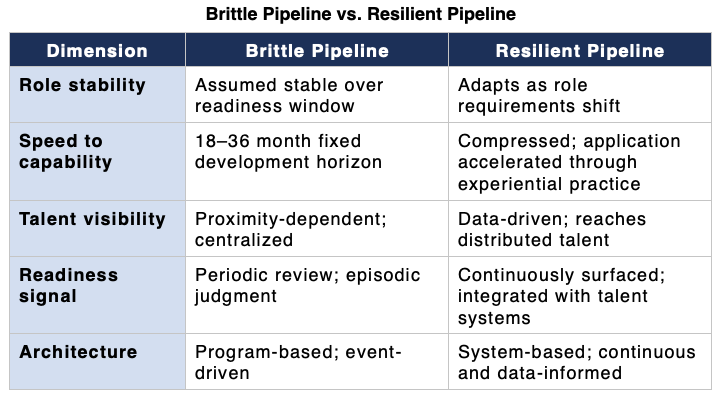
The standard leadership readiness model assumes a defined timeline: spot potential, develop over 18 to 36 months, then promote. This approach is only effective when roles remain stable.
Volatility shortens the readiness window and compresses speed to capability. Leadership vacancies are increasing due to retirements, talent market attrition and restructurings driven by AI and market changes. Meanwhile, the competencies required at the end of the readiness period often differ from those targeted at the start. As a result, organizations may prepare leaders for roles that have already changed.
Brandon Hall Group™ award-winner data shows how leading programs respond. Experiential and simulation-based learning appeared in 57% to 100% of award-winning programs, accelerating competency acquisition by connecting development and application. Action learning projects were present in 43% to 100% of cases. Follow-up impact surveys at 3 to 12 months, used by 57% of programs, demonstrate that readiness is an ongoing trajectory requiring sustained measurement.
NovoEd’s Learn+ supports this architecture. Built for both cohort-based and self-paced delivery, it integrates peer collaboration, team assignments and structured discussion into the development experience. Leaders practice alongside colleagues dealing with similar challenges, building shared reference points and applied judgment beyond what formal content alone can provide. Learn+ works with existing LMS infrastructure, allowing development data to flow into the wider talent management system without requiring a separate platform.
Distributed Talent, Distributed Risk
Most organizations now manage leadership talent across geographies, business units and hybrid work structures, making traditional visibility mechanisms unreliable. Hallway conversations, sponsor relationships and informal observations depend on proximity that distributed organizations lack. Leaders who would be visible in a centralized model may be overlooked in a distributed one, not due to lack of capability, but because the infrastructure for surfacing readiness does not reach them.
Mentoring, used in 81% of award-winning leadership programs, is especially vulnerable. When relationships rely on proximity or informal networks, they tend to cluster in central offices rather than reaching distributed talent.
NovoEd’s Mentor+ closes this gap. Launched in 2025 and based on accredited mentoring science developed with the Center for Mentoring Excellence, Mentor+ structures every relationship for purposeful, measurable development regardless of location. Automated cues keep relationships active and the platform’s data capture provides administrators with actionable insights into progress, engagement and skill development. Integrations with MS Teams, calendar tools and video platforms support mentoring within the flow of work, without additional logins or scheduling challenges.
NovoAI’s Discussion Insights further enhance this by synthesizing themes across mentoring conversations at scale, identifying where development is progressing or stalling without requiring L&D to review each exchange. For organizations extending leadership readiness across distributed teams, this enables structured mentoring independent of physical proximity, with AI-generated visibility into effectiveness.
Accelerating Readiness Through Applied Development
Pipeline resilience is measured in large part by speed to capability: how quickly an organization can move a leader from potential to demonstrated, applied performance. NovoEd’s Practice+ addresses the application layer that many leadership programs overlook. Scenario-based practice rooms allow emerging leaders to record and submit responses to real-world situations. Managers and mentors provide structured feedback through rubrics, ratings and comments targeting specific skills, creating actionable feedback loops. NovoAI’s Practice Insights analyzes submissions for speech rate, key phrases and communication patterns, offering learners targeted guidance that builds a visible skill development record over time.
This measurement infrastructure is important beyond the individual learner. Brandon Hall Group™ research shows 92% of award-winning leadership programs were integrated with wider talent management systems, ensuring development data informs promotion, succession and performance management. NovoEd connects with existing LMS and HR systems for this reason: Readiness becomes a continuously surfaced metric, not just a judgment call.
The results of this approach are evident in practice. NovoEd’s partnership with Entelechy on the Developing Frontline Leaders program for Thermo Fisher Scientific earned Gold and Silver honors in Brandon Hall Group™’s 2025 HCM Excellence Awards®, recognizing the program for prioritizing skill development and real-world application throughout the leadership experience.
Naming the Problem: Pipeline Brittleness
To address Pipeline Brittleness, organizations must thoroughly review their succession frameworks and act immediately. Modernize leadership pipelines, invest in continuous development infrastructure and use integrated, data-driven tools to build strong and adaptable talent systems. Do not wait for further disruption.
Pipeline brittleness arises when succession infrastructure is built for stable roles, long readiness windows and centralized talent visibility but is expected to perform under changed conditions. This is not a failure of investment or intent, but a failure of architecture.
Organizations at Phase 4 of Brandon Hall Group’s Leadership Development Progression Model, the 10% with fully integrated, data-driven, continuously refined development systems, have moved beyond brittle pipelines. They are building readiness as an ongoing capability. The rest have the evidence and the architecture available to them.