Sometimes an analyst briefing leaves you with a list of product updates. Other times, it changes the questions you are asking about the business. My time at HiBob’s analyst roundtable during HR Tech 2026 did the latter.
I joined the discussion representing Brandon Hall Group™, interested in HiBob’s growth strategy, expansion of its product ecosystem, payroll direction and plans for AI. We covered all of those areas. What stayed with me was how consistently the conversation moved beyond traditional HR technology into finance, organizational decision-making and the realities of managing a workforce that changes in real time.
That shift matters. HR systems have long been expected to store employee information and support key processes. The next challenge is different: how can that information help leaders make better decisions about talent, cost, growth and performance? Throughout the roundtable, I kept coming back to that question.
Growth Is No Longer a Single-Lane Strategy
One of the early themes was HiBob’s approach to growth. The company described a strategy moving in four directions at once: customer segment, geography, executive audience and product portfolio. These are distinct paths, but together they help explain why HiBob is positioning itself for a broader role in the enterprise.
HiBob continues to serve smaller and midsize organizations while moving further upmarket toward larger, more complex employers. HiBob already has an established global presence, with Europe representing a much larger share of its business today. However, expanding its footprint in the United States is a significant strategic priority for 2027 and represents an important opportunity for the company’s continued growth. The product conversation now extends beyond core HR into payroll, finance, talent management and workforce planning. The audience is widening from the CHRO to include the CFO and CIO.
That ambition has also been supported by a publicly announced $166 million investment led by Salesforce. The investment is notable, but what interested me more was the thinking behind it. Growth across multiple dimensions requires a platform that serves diverse stakeholders without creating fragmented experiences or disconnected data. The promise is not simply more products. It is a more connected understanding of the organization.
For a company broadening its reach, the difficult part is not only winning new customers but also continuing to solve more sophisticated problems as existing customers grow, change, acquire businesses and rethink how work gets done. That is where the strength of the underlying platform becomes especially important.
The CFO Belongs in the Workforce Conversation
This part of the roundtable resonated with me. Before moving into my work in HR and leadership development, I served as a Chief Financial Officer. I understand why conversations about workforce technology can become difficult when HR focuses on capabilities and experience while finance focuses on costs, risk, productivity and return on investment.
Workforce costs make up a significant share of operating expenses for many organizations. Yet the information used to make talent decisions and the information used for financial planning often reside in different places. HiBob’s emphasis on serving the CFO’s office, through areas such as payroll and connected finance capabilities, points to an opportunity to bring those conversations closer together.
Consider the decisions leaders make every day. Where should we add capacity? Which skills should we build rather than buy? How will an acquisition change our workforce requirements? What are the financial implications of an organizational redesign? These are not exclusively HR or finance questions. They are business questions and HR needs to be central to answering them.
I also appreciated the inclusion of the CIO in this conversation. As organizations adopt more AI-enabled systems, technology governance, integration and access to reliable data become integral to workforce strategy. The CHRO, CFO and CIO may enter with different priorities, but increasingly they need a shared understanding of the organization.
Payroll Is Becoming a Strategic Data Discipline
The payroll discussion, led by Yoav Gur, HiBob’s GM of Payroll, added another dimension to that story. Payroll is sometimes treated as a necessary transaction at the end of an HR process. But one point from the discussion stayed with me: payroll has a way of exposing weaknesses in the information that precedes it.
Employee records, employment arrangements, compensation details, organizational changes and approvals must all be accurate. When they are not, the consequences become apparent quickly and can directly affect employees. In that sense, payroll is more than a recurring process. It is an ongoing test of data quality and operational discipline.
HiBob discussed its approach across native payroll, connections with external payroll providers and managed services tailored to organizations with different operating needs. The broader ambition is to make workforce and payroll information more connected, regardless of whether the same provider processes every payment.
From a business perspective, that distinction matters. Getting people paid correctly and on time is nonnegotiable. But when payroll data is linked to reliable people, role and organizational information, the business is better positioned to understand workforce costs, plan effectively and make informed decisions. Accuracy is the foundation. Better decisions are the opportunity.
From a System of Record to Organizational Intelligence
The product conversations carried that theme forward. HiBob’s team described a progression from a trusted organizational foundation to organizational intelligence and then to intelligent action. I found that sequence useful because it recognizes something that can be lost in the excitement about AI: intelligent outputs are only as dependable as the context and controls behind them.
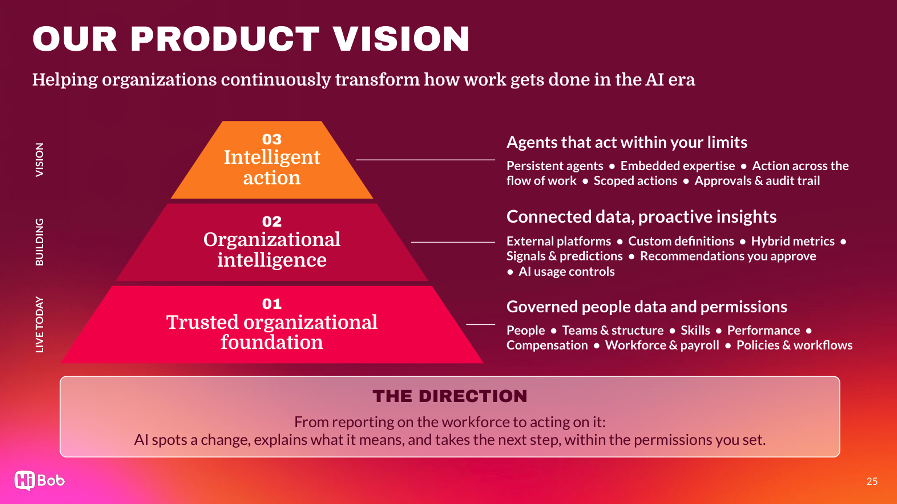
A person’s role is more than a job title. Their work is shaped by reporting relationships, skills, location, employment arrangements, permissions and the organization’s priorities. Those relationships become especially important when managers make decisions about succession, development, compensation, or workforce planning. AI needs that context to be useful beyond producing a fluent answer.
The discussion also included Bob Companion and a network of specialized AI agents, as well as HiBob’s collaboration with The Josh Bersin Company to bring Galileo-powered guidance into Bob. That combination reflects a broader move toward placing expertise and information closer to the decisions managers already make.
Two other developments illustrate the direction. Bob MCP, which HiBob has publicly documented, enables supported AI environments to connect to Bob capabilities with governed access. Bob Studio, scheduled for release in Q1/2027, has also been publicly previewed to support more tailored workflows and experiences within the platform. The specific capabilities will continue to evolve, but the strategic question is already clear: can the organization move beyond reporting what happened and help people decide responsibly what to do next?
Scaling Upmarket Without Losing Simplicity
Another discussion focused on the complexity of serving larger organizations. A growing business may operate across multiple legal entities, cost centers, countries and reporting lines. Employees may work on multiple projects, hold more than one assignment, or operate within structures that do not fit a simple organization chart.
These details can sound technical until they affect a manager trying to approve an action, a finance leader trying to understand workforce costs, or an employee trying to navigate a process. Organizational structure is not just a static display on a screen. It determines responsibility, access and the accuracy of the information that AI systems may rely on.
HiBob emphasized supporting those realities while preserving the ease-of-use customers expect. That balance is harder than it sounds. Complexity often builds gradually through acquisitions, international growth and evolving employment models. A platform that works well today must still make sense when an organization looks very different a few years from now.
I appreciated the ambition to anticipate these changes rather than wait for customers to reach a system’s limits. The test will be whether that flexibility remains practical for people across the business.
AI Adoption Is Only the Beginning
AI was woven throughout the roundtable, but the most useful part of the discussion was a shift in emphasis. The question is no longer simply whether people will use AI. It is whether organizations can understand what that use accomplishes.
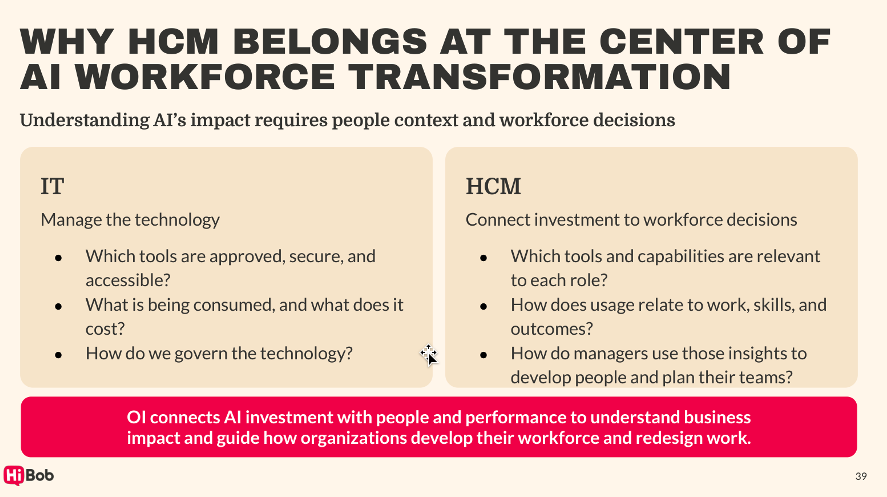
HiBob introduced a particularly relevant concept: the token economy. As organizations integrate more AI tools into workflows, consumption-based costs can become a meaningful operating consideration. Technology leaders may focus on model selection, usage and optimization. Those issues are important, but they do not answer the question that matters most to the business: what value are we creating?
That is where the former CFO in me immediately starts asking questions. Are we paying for more activity, or are we seeing better decisions, stronger performance and more effective use of people’s time? Can we link AI consumption to the roles, skills, goals and work outcomes that matter? Increased usage alone is not a return on investment.
The roundtable explored the possibility of examining AI usage alongside workforce data, performance metrics and operational signals from tools already in use across the business. I see promise in that approach, provided organizations are thoughtful about measurement. Counting tokens will not tell us whether a team is more capable. The meaningful question is whether the work is improving and whether the people doing it are being supported to succeed.
Trust and Governance Must Travel With Intelligence
Another valuable part of the discussion focused on governance. The team emphasized the importance of controlling which employee information AI can access and ensuring that permissions remain in effect when information moves into AI-enabled experiences or external connections.
That is not a minor technical matter. Talent, pay, performance and employee information can be sensitive. The usefulness of AI does not relieve an organization of its responsibility to manage access appropriately, understand how a recommendation was generated and preserve human accountability for consequential decisions.
I was particularly interested in the distinction between flexible AI reasoning and the more structured rules required in areas such as payroll, compensation and compliance. Organizations need room for technology to synthesize and assist, but they also need clarity on where deterministic controls and human review must prevail.
To me, trust is not something an organization can add after an AI feature launches. It must be built into the information, permissions, processes and leadership expectations that surround the technology.
Tomorrow’s Managers May Lead People and Agents
One forward-looking idea especially caught my attention: managers may increasingly be responsible for coordinating work performed by both people and AI agents. The idea raises a much bigger question than how technology will be deployed. It asks what leadership will require as a team’s composition changes.
Managers will need to understand what work should be delegated, what must be reviewed, how performance is evaluated and who remains accountable when automated actions have real consequences. They will also need to continue coaching people, building trust and creating development opportunities as work is redesigned around new capabilities.
This is why I view the next phase of AI as a leadership development challenge as much as a technological one. Organizations cannot assume that adding agents automatically creates a more capable workforce. Leaders must be prepared to exercise judgment, communicate expectations and preserve the human connection that makes teams effective.
Paysafe: Technology Change Is Still Human Change
The Paysafe customer discussion brought these ideas into a practical setting. Jessica Clifton, who shared the company’s experience, described moving from a long-standing SAP SuccessFactors environment that had become difficult to maintain after years of customization. Paysafe chose to rethink its processes rather than simply recreate the old system on a new platform.
According to the discussion, the team implemented a broad set of HiBob capabilities in roughly seven months with a small internal implementation team. Early employee engagement after the September 2026 go-live was encouraging. The practical outcomes were just as important as the timeline: managers gained more direct visibility into requisition approvals, showed greater initiative around employee goals and had a higher level of self-service.
What stayed with me was not the speed of the transition. It was Paysafe’s emphasis on owning implementation knowledge internally. The lesson was not to lift and shift existing processes without questioning them, but to use a platform change as an opportunity to rethink how work should be done. I also appreciated the emphasis on having a proactive partner and an active user community to support the people doing the work of change.
That is an important reminder for HR leaders. A system can introduce valuable capabilities, but the success of a transformation still depends on the people leading it. Employees need clarity. Managers need confidence. Internal teams need the knowledge to sustain and improve the system after the launch team has moved on. Technology change remains human change.
What the HiBob Roundtable Reinforced for Me
As I reflect on HiBob’s analyst roundtable at HR Tech 2026, I keep returning to the connection among three things organizations too often discuss separately: workforce data, business outcomes and leadership capability.
We heard a growth strategy spanning markets, products and executive audiences. We discussed payroll as a discipline that depends on trustworthy data, organizational intelligence as a way to make that data more useful and AI economics as a reason to focus on outcomes rather than activity. We also heard from Paysafe about the very human work required to turn a technology decision into a functioning change in the business.
For me, the broader takeaway is that the future of HR technology will not be defined solely by how many processes it can automate or how much information it can hold. It will be defined by whether that technology helps leaders make better, more responsible decisions about people and performance.
That requires HR to connect more directly with finance and technology. It requires information leaders can trust. And it requires leadership development that keeps pace with how teams and work are changing. Technology can make insight available. It still takes people to ask better questions and act thoughtfully on the answers.
My sincere thanks to the HiBob team, including the leaders who shared their perspectives and to Jessica Clifton and the Paysafe team for contributing the customer perspective. The discussion was a useful reminder that the strongest HR technology strategies go beyond helping organizations manage their people. They help organizations understand what their people and their business need next.