Organizations have been talking about skills for years, but the urgency is different now. AI is changing jobs faster, career paths are becoming less predictable and the capabilities organizations need are continually evolving. At the same time, employees increasingly expect development to continue throughout their careers rather than end with a degree, onboarding program or occasional training course. That combination is putting learning in a very different position.
So if it isn’t about more content, what is it about? The challenge is no longer simply providing more content or giving employees access to more learning. Organizations need to understand which skills matter, how people actually develop them and whether those capabilities are translating into stronger performance and meaningful business outcomes.
Over the past year, Brandon Hall Group has explored these questions with Instructure through research, executive conversations and an in-depth examination of how learning technology is evolving to support a more skills-driven and lifelong approach to development. The bigger opportunity is to connect learning much more closely with the work people do, the capabilities they need and where they want to go next.
The Skills Conversation Has to Move Forward
Almost every organization will tell you it is focused on skills, but the harder question is what that actually means.
Skills can mean technical capabilities, durable or human skills, readiness capabilities, learning outcomes or some combination of all of them. Organizations can spend enormous amounts of time trying to create the perfect taxonomy without first answering a more important question: which capabilities matter to our organization, and what do we need people to be able to do differently as a result? That’s the question most taxonomies never actually answer.
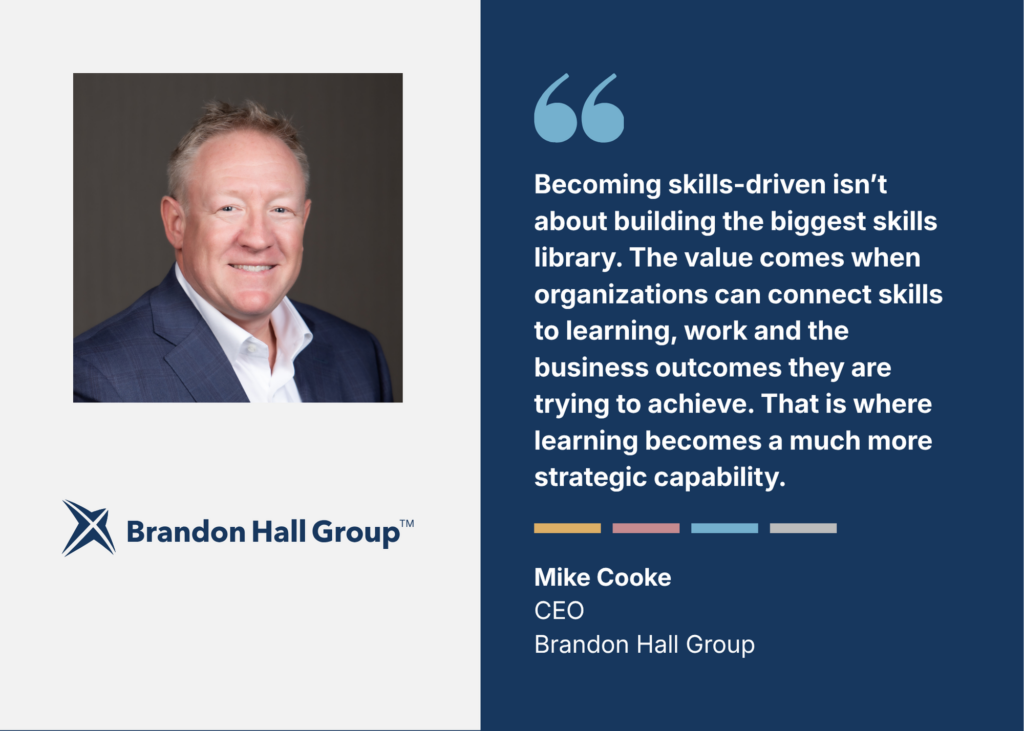
That connection to outcomes is critical. In our conversations with Instructure Chief Learning Officer Melissa Loble, she described skills as inherently contextual. There is not one universal set of skills that every organization can adopt. The skills an organization needs should reflect its strategy, culture, workforce and the outcomes it is trying to achieve.
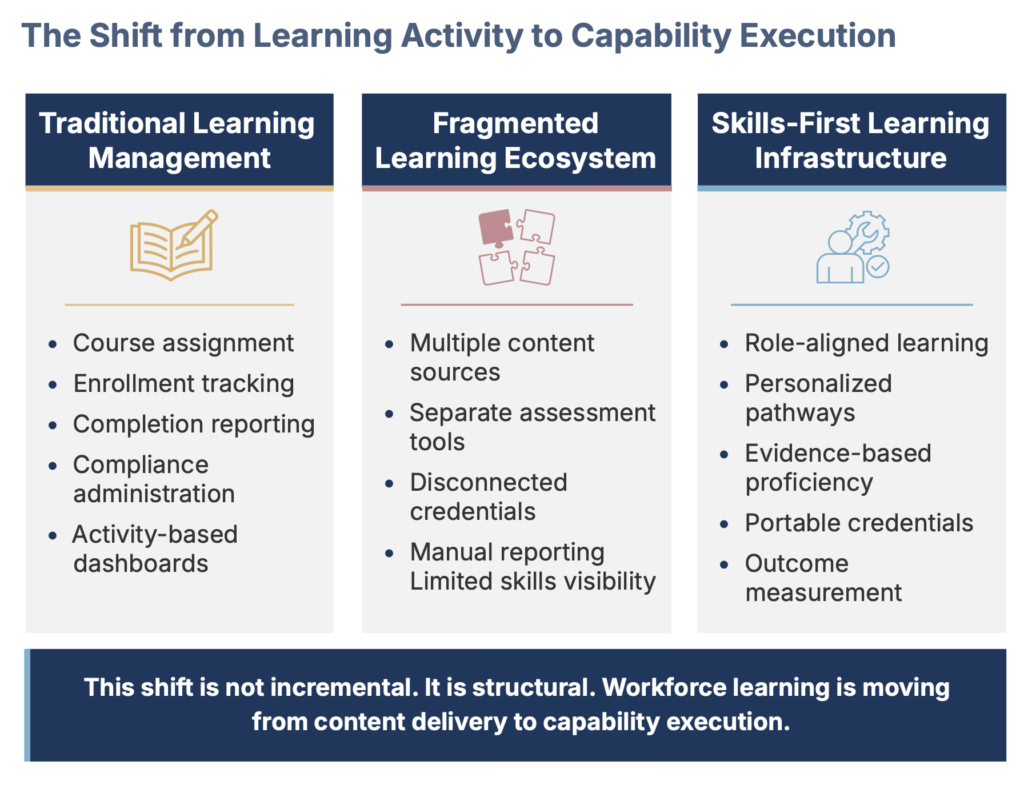
That changes the role of learning. Instead of beginning with a library of available content and asking employees to consume it, organizations can begin with the capabilities required to move the business forward and then design learning experiences around those outcomes.
Learning Is Becoming a Lifelong Experience
The shift toward skills is happening alongside another fundamental change: learning itself no longer belongs to a particular phase of someone’s life.
Education, professional development, reskilling and career mobility are increasingly interconnected as people move between school and work, into new roles, across functions and sometimes into entirely new careers. The capabilities they need continue to change throughout that journey, which means development cannot be treated as a series of isolated learning events. It has to become continuous.
That idea of lifelong learning becomes increasingly important when organizations cannot confidently predict what many jobs will look like several years from now. The goal cannot always be to prepare someone for one fixed destination. Organizations also need to help people become better learners.
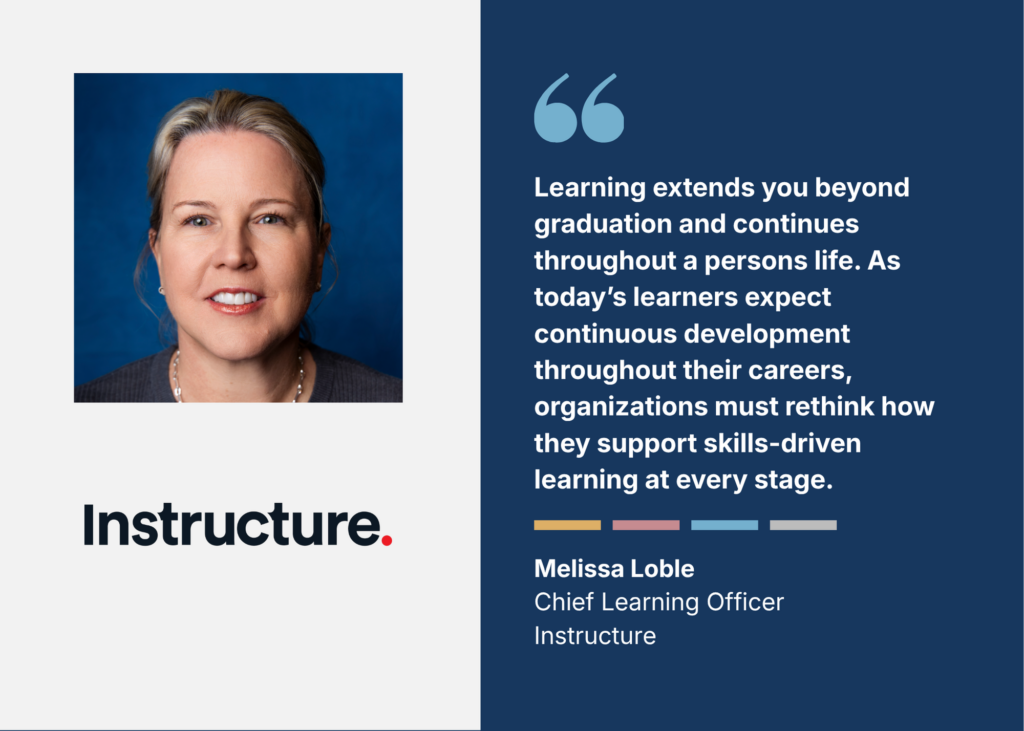
In our Excellence at Work conversation with Loble, she described a future in which learners have greater agency over their development, including the ability to understand career interests, see the capabilities connected to different paths, identify what they need to develop and make more informed choices about their own learning.
That is an important evolution from assigning learning to employees toward helping them navigate development.
Explore the Research: The Instructure Bellwether
Brandon Hall Group’s latest Bellwether research examines the changing learning technology landscape and takes an in-depth look at Instructure’s approach to supporting lifelong, skills-driven learning.
The research considers the market forces reshaping learning, the capabilities organizations increasingly require and how technology can help connect learning experiences with skills development and organizational outcomes. Rather than looking at learning technology simply as a system for delivering courses, the research asks a larger question: how can organizations build an environment where learning continually helps people develop the capabilities they need next?
Read the Instructure Bellwether Report
Skills Need to Connect to Careers and Work
Identifying skills is only one part of the challenge. Employees also need to understand why those skills matter and how they connect to what comes next.
A skills architecture becomes much more useful when organizations connect capabilities with career paths, manager conversations, development opportunities and the work employees are doing every day. In our conversation with Instructure, Loble described taking skills beyond job mapping and into career ladders, coaching conversations and learning so that employees can understand a capability in the context of both their current work and their future direction.
This is also where learner agency becomes much more practical. Employees should increasingly be able to see what capabilities their current role requires, what skills are connected to a role they may want next, where their gaps are, what experiences can help them develop and whether they can actually apply what they learned.
Those connections bring learning, talent development and career mobility much closer together.
Learning Has to Be Designed Around Outcomes
For years, learning organizations have had easy access to activity metrics such as completions, attendance, hours of training and course ratings. Those measures tell us something, but they do not necessarily tell us whether anything changed.
The more important questions are whether someone developed a capability, whether their behavior changed, whether performance improved and whether the organization became more capable of executing its strategy.
The Bellwether makes that gap visible. Many organizations have defined a skills strategy, created taxonomies, mapped content and learned how to track participation, but far fewer have moved into measuring proficiency, validating application in the work and proving business impact.
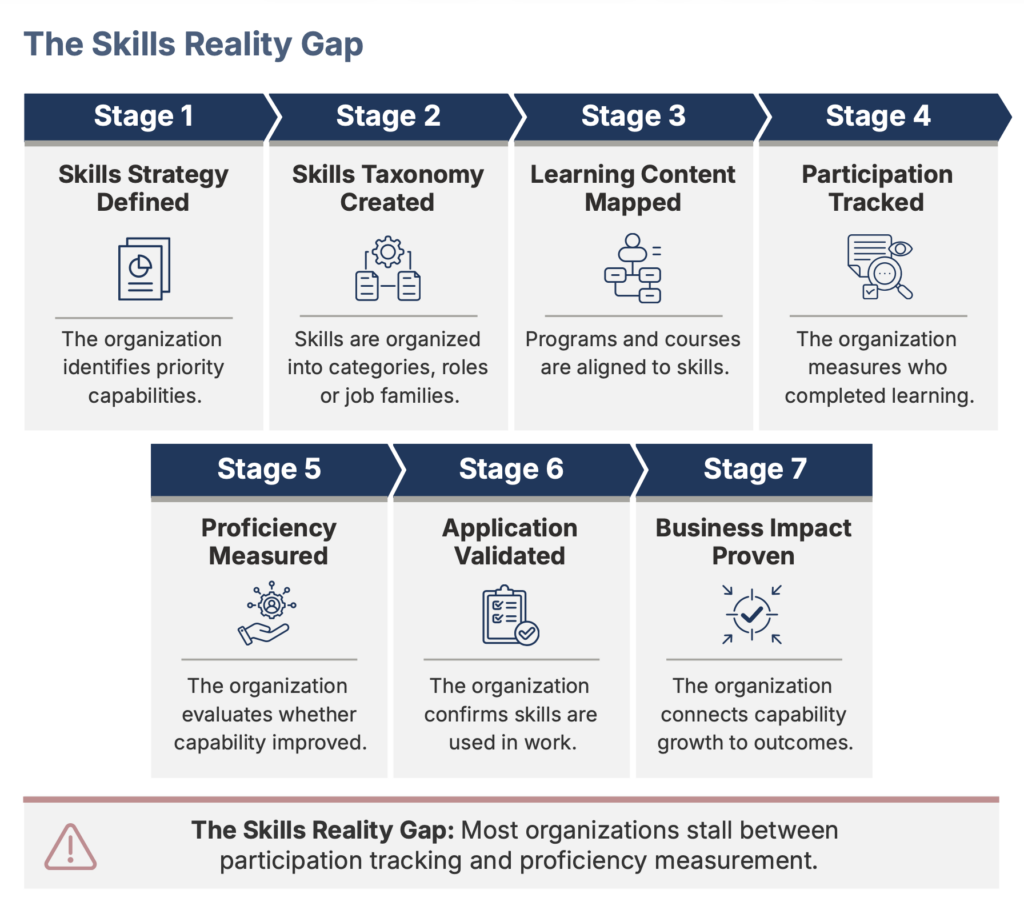
This is one of the strongest visuals in the report for this article because it shows exactly where many organizations are getting stuck. The gap is not in defining skills or assigning learning. It is in determining whether capability improved and whether that capability is actually showing up in the work.
That distinction also came through clearly in our conversations with Instructure. Learning becomes more meaningful when employees understand why it matters to the organization and to them personally. Even something as traditional as compliance training changes when an organization connects the experience with a real business reason rather than presenting it simply as something employees are required to complete.
For L&D teams, that means working backward from the outcome, understanding the learner and the capability that needs to change, and then designing the experience around that need.
From Skills Strategy to Learning in Practice
We explored many of these issues further in our recent Brandon Hall Group webinar with Instructure, where the conversation focused on how organizations can move beyond the broad ambition of becoming skills-driven and begin connecting learning strategy with capabilities, workforce priorities and measurable outcomes.
The discussion makes the point that organizations do not need to redesign every learning experience at once. Transformation can begin with a particular workforce challenge, capability gap, team or business outcome where there is both urgency and commitment.
Instructure’s own experience provides a useful example. Loble described beginning with targeted groups where a specific outcome needed to improve rather than attempting an organization-wide transformation immediately. Her principle is simple: pick small and pick passion. Start where there is a real problem to solve and people who care deeply about solving it, create an opportunity to experiment and measure what changes, and then expand the approach when there is evidence that it works.
AI Changes What Learning Can Look Like
No discussion about the future of learning can ignore AI, but the opportunity extends well beyond using AI to create courses faster.
AI can help organizations create more contextual learning experiences, understand previously difficult-to-analyze learner data and give employees support at the moment they need it. One area already beginning to change is personalization, particularly in scenario-based and simulation-based learning that has historically required significant time and resources to build.
AI can dramatically expand those possibilities by helping organizations create experiences that reflect different roles, environments and situations. That does not necessarily mean creating a completely unique experience for every employee. It can mean making learning more relevant.
Cybersecurity training for a salesperson may emphasize different scenarios than the same training for someone in customer success. Leadership development can reflect the actual decisions leaders face, while skills development can be placed into the context in which the employee will need to apply it.
AI can also help organizations understand learning differently. Loble described the opportunity to capture more of the learner experience and use AI to identify patterns within information that previously would have been difficult to analyze at scale.
That creates the potential to move learning analytics beyond reporting activity and toward understanding what is actually happening during development.
The Learner Cannot Get Lost in the Technology
As learning technology becomes more intelligent, organizations need to be careful not to design learning around the technology itself.
The learner still matters most.
Organizations have multiple generations in the workforce, different functions, different levels of experience and people with very different motivations for development. Learning for a salesperson may need to feel different from learning for someone in customer support, and someone preparing for their next role may engage differently from someone developing deeper expertise in their current one.
The answer is not necessarily hyper-personalizing everything. It is knowing enough about the audience to make learning relevant.
Loble described this as a form of backward design: understand the outcome, understand who needs to achieve it and then build the experience accordingly.
That principle becomes even more important as AI gives organizations the ability to create more content and experiences than ever before. More content is not necessarily better learning. Relevance, context and application matter more.
A Conversation About Skills, Learning and the Future of Work
In an earlier episode of Brandon Hall Group’s Excellence at Work podcast, I sat down with Melissa Loble for a broader conversation about skills and the changing role of learning.
The discussion goes well beyond technology as they explore why organizations struggle to define skills, how learning can connect more directly with business outcomes, why employees need greater agency over their development and how AI can help organizations understand learning and talent in new ways.
One of the strongest themes from that conversation is also one of the simplest: learning matters when people can use it.
Loble’s own perspective comes from seeing people apply something they learned later in their work or lives, because those moments of application provide evidence that the experience actually created something meaningful.
That is ultimately what a skills-driven strategy should be trying to produce. Not more content, but more capability.
What Learning Leaders Should Be Thinking About
For learning leaders, the implications are practical. Start with the business outcome rather than the content library and determine what the organization needs people to do differently before deciding what learning to provide.
Skills should be defined in the context of the organization’s own strategy and workforce rather than assuming a generic taxonomy will be enough. Those skills then need to connect with careers and everyday work so employees understand why development matters and where it can take them.
Organizations should also give learners greater agency over the choices they can make while still providing structure and direction. Most importantly, learning leaders need to measure whether capability and behavior actually change rather than relying on completion as the primary evidence of success.
AI can make all of this more relevant and more scalable, but its value should be judged by whether it improves context, personalization, insight and support, not simply by whether it produces more content.
The Bigger Picture
Learning is becoming too important to remain disconnected from the way organizations think about skills, careers and business performance.
The pace of change makes it increasingly difficult to prepare employees once and assume those capabilities will carry them through an entire career. Organizations need people who can continually learn, apply new capabilities and adapt as work changes.
That requires more than a learning platform. It requires an environment that connects what people need to know, what they need to be able to do, where they want to go and what the business needs from them.
The thread running through all of this is connection. Not more learning, not more content, but learning that stays connected to the work, the person and the outcome the business actually needs.
Explore Instructure on TotalTech®
Organizations evaluating learning technology can continue their research through Brandon Hall Group’s TotalTech platform.
The Instructure Solution Provider Profile provides a closer look at the company, its solutions and capabilities, giving learning and HR technology leaders another resource as they evaluate their technology ecosystem.
Explore Instructure on TotalTech:
https://totaltech.brandonhall.com/provider/instructure/
Continue Exploring
Read the Research
https://web.brandonhall.com/skills-driven-learning-business-outcomes
Watch the Webinar
https://youtu.be/VC45px67e3A
Watch the Podcast
https://youtu.be/R2eiI4QTNUs
Explore Instructure on TotalTech
https://totaltech.brandonhall.com/provider/instructure/
Instructure is a Brandon Hall Group Eminence Partner. Through the Eminence Program, Brandon Hall Group works with leading solution providers to examine emerging workforce challenges, technology innovation and the practices shaping the future of HR, Talent and Learning.