Brandon Hall Group’s analysis of award-winning leadership development programs found that 100% of organizations achieved strategic business alignment and sustained their programs through ongoing program expansion. These organizations have embedded development into their business operations, continuously refining, measuring and broadening its scope. The commitment to continuous improvement is not just a design element; it is a core operating philosophy.
The Brandon Hall Group™ Leadership Development Progression Model for Empowering HR Excellence tells the same story from the maturity side. Only 10% of organizations have reached Phase 4 (Optimized), where leadership development is fully integrated with succession planning, continuously refined through data analytics and treated as an ongoing organizational capability rather than a periodic event.
The 43% of organizations in Phase 2 (Standardized) have established consistent programs but have treated consistency as the endpoint rather than the starting point.
The L&D Progression Model for HR Excellence reinforces it. At Phase 4 (Optimized, 17% of organizations), L&D operates as a proactive strategic partner with AI adopted across functions, data-driven decision-making embedded in the process and real-time performance management replacing annual review cycles.
At Phase 2 (Standardized, 28%), organizations have an LMS and a content library. The difference between these phases is not technological but architectural, reflecting fundamentally different views of what a development system should achieve.
Brandon Hall Group’s AI for Business Impact study reinforces this finding: 100% of award-winning organizations implemented personalized learning paths and real-time analytics as permanent infrastructure. Microlearning was integrated into nearly all of programs and just-in-time performance support was widely present. These are ongoing system capabilities, not isolated program features. They provide real-time insights to managers and L&D leaders without waiting for program completion.
Programs vs. Systems: The Structural Difference
A program has clear boundaries: a start and end date, a participant list and a completion rate. It is designed, launched, delivered and measured as a standalone effort. When a new need arises, another program begins. In contrast, a development system operates continuously. Programs are not inherently flawed. The prevalence of face-to-face workshops and widespread use of blended learning in award-winning programs show that structured learning remains essential to high-performing development.
The issue occurs when development is structured solely as programs, rather than as a continuous system that supports ongoing capability building.
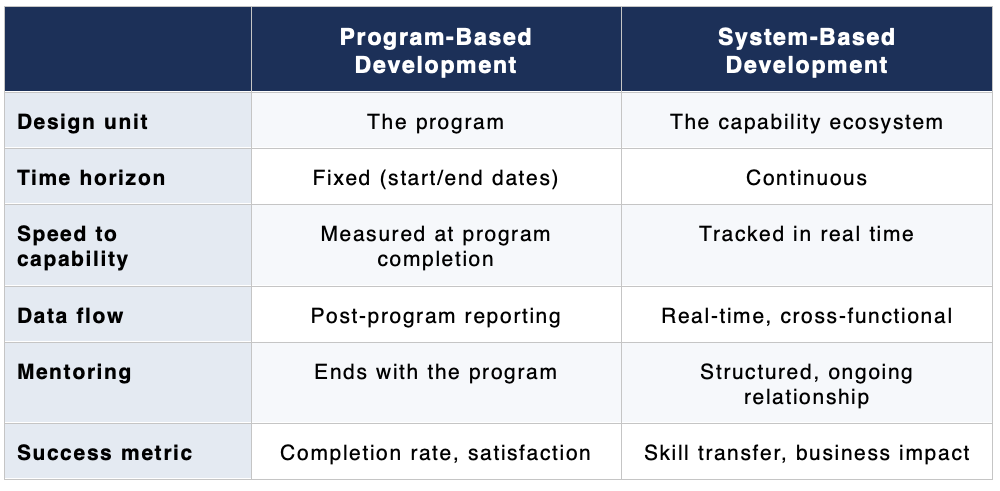
A learning architecture is a system of interconnected capabilities, content, practice, mentoring, analytics and feedback that operates continuously and informs itself in real-time. Skills identified in one area influence decisions in another. A manager’s coaching connects to a learner’s development path and practice submissions generate data that shape future content. Development continues beyond cohort graduation.
Brandon Hall Group™ award-winner data shows this implementation at scale. Award-winning leadership programs were connected to wider talent management systems, such as promotion criteria, succession planning and performance management, ensuring development data informed organizational decisions. Additionally, nearly all used technology both for delivery efficiency as well as for scalability and continuous feedback, empowering effective architecture across global organizations.
This distinction changes what organizations require from technology partners. Technology for programs manages discrete learning events, whereas technology for systems enables continuous, adaptive development. An LMS optimized for program delivery executes the design but a platform for continuous capability development identifies trends and responds, supporting a system as opposed to isolated programs.
NovoEd as Learning Architecture
NovoEd, a Diamond-level Brandon Hall Group™ Smartchoice® Preferred Provider and Gold Medal winner in all entered categories of the 2025 Technology Excellence Awards, was designed specifically for the continuous, integrated model described in the research.
The platform unites Learn+, Practice+ and Mentor+, all powered by NovoAI, its proprietary AI suite, into a system where each component shares data and supports the others.
Learn+ supports essential cohort-based and joint program experiences, but goes beyond delivery. Team workspaces, peer discussions and threaded feedback keep learning active after course completion.
Drill-down dashboards provide administrators, managers and stakeholders with real-time visibility into engagement, skill mastery and program outcomes at all levels, from individual learners to organization-wide trends. Integration alongside existing LMS infrastructure ensures development data flows into the broader talent ecosystem without requiring a separate system.
Practice+ adds the application layer often missing from program-only architectures. Scenario-based practice rooms allow employees to record and submit responses to real-world challenges, such as difficult conversations, stakeholder presentations and high-pressure decisions, before facing them live. Managers and mentors provide structured feedback using rubrics, ratings and threaded comments focused on specific skills. NovoAI’s Practice Insights analyzes submissions for speech rate, key phrase usage and communication patterns, offering actionable feedback that builds a visible record of skill development. Practice+ is designed to build muscle memory and improve decision-making under pressure, resulting in demonstrated confidence, not just knowledge.
Mentor+ extends the architecture into the relationship layer, which is often most affected by Program Thinking, as mentoring relationships formed during programs typically end when the program concludes.
Developed with the Center for Mentoring Excellence, Mentor+ uses accredited mentoring science to structure every relationship for purposeful, measurable development through guided conversation frameworks and automatic action-item tracking.
Integration with MS Teams, calendar tools and video platforms allows mentoring to occur within the flow of work, eliminating extra logins or scheduling barriers. NovoAI’s Discussion Insights synthesize themes across mentoring conversations at scale, revealing areas of progress and those needing reinforcement, without needing manual review by L&D.
When these components work together, the learn-apply-coach cycle seen in award-winning organizations becomes the system’s default state, not an aspiration requiring extraordinary effort.
Naming the Problem: Program Thinking
Program Thinking is the organizational habit of addressing capability needs with standalone, well-designed and well-intentioned events, without building the connective architecture needed for continuous, cumulative and responsive development.
This approach results in high completion rates but inconsistent skill transfer. It produces strong satisfaction scores but weak succession pipelines. In volatile conditions, it leaves organizations behind, always developing capabilities suited to past needs.
Shifting from Program Thinking to learning architecture is primarily a design decision, not a technology choice. It means building systems for continuous capability development rather than periodic program delivery. The 10% of organizations at Phase 4 of Brandon Hall Group’s™ Leadership Development Progression Model, the 17% at the optimized tier of the L&D model and the 100% of award-winning AI adopters with permanent personalized learning and real-time analytics didn’t simply improved programs. Instead, they built a fundamentally different system.
What these organizations are building together represents an emerging operating model: continuous capability development, where learning, practice and coaching function as an integrated system rather than a sequence of programs. The architecture exists and the evidence is clear. The remaining step is the decision to build.