Brandon Hall Group™ research on performance management programs reveals a persistent paradox: Organizations report high program completion and active reviews, yet have difficulty demonstrating business impact. Measurement shapes outcomes. Measuring completion builds compliance. Building for capability builds an agile workforce.
The Measurement Gap Is Hiding in Plain Sight
Ask most organizations how their performance management and talent development programs are going and you’ll hear familiar answers: participation rates are up, review cycles are running on schedule, goals are being set and tracked and the system is largely working as designed.
What tends to go unasked and unanswered, is whether any of it is making people measurably better at their jobs.
Brandon Hall Group™ analysis of HCM Excellence Award® winners reveals an instructive pattern. Across high-performing organizations recognized for best practices in performance management, 86% had implemented cascading company goals and role-specific KPIs. Seventy-one percent conducted annual performance evaluations and 71% held regular one-on-one meetings between managers and employees. These are the structural hallmarks of a functioning performance system.
Look at what’s missing from that picture. Only 14% of these same organizations had deployed AI-powered performance insights, used predictive talent analytics or had implemented forward-looking tools, the systems designed to guide future development rather than evaluate past performance.
Backward-focused measurement underestimates future capability gaps.
When Reported Success Isn’t Real Impact
There’s a particular kind of blind spot that thrives inside performance data: the conflation of program completion with program value.
A learning program achieves 95% completion. A review cycle closes on time with high participation. Satisfaction surveys return favorable scores. Every dashboard metric is green. And six months later, the business still can’t execute on a new strategic priority because the people who need to lead it lack the skills to do so.
This is more common than most organizations acknowledge, because the metrics signaling “success” are the metrics easiest to count.
Brandon Hall Group™ research finds that organizations with lower talent management progression focus on activity and reaction: Did employees complete training? Did managers conduct reviews? Did participants rate experiences positively? These smile sheets come up short in today’s business climate.
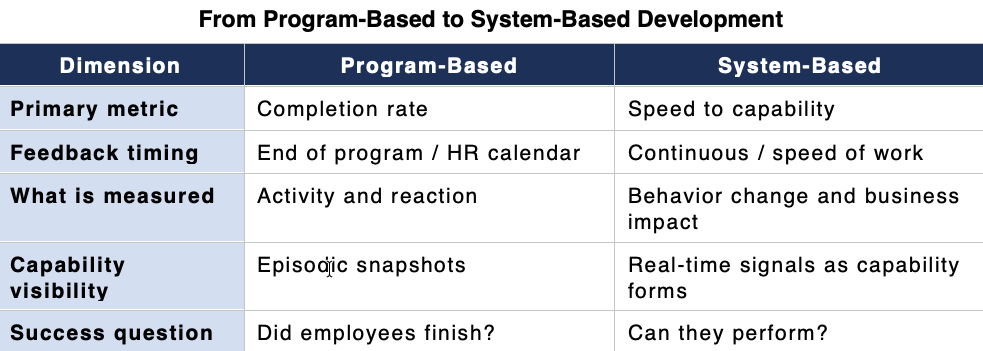
Organizations at the Strategic and High-Impact tiers of Brandon Hall Group’s Talent Management Progression Model for Empowering HR Excellence frame the evaluation differently. Did behavior change? Did performance improve in ways that affected business outcomes? What was the speed to capability, how fast did individuals move from learning to applied proficiency? Those answers don’t come from a completion report. They require a fundamentally different measurement architecture, one most organizations haven’t yet built.
Capability Velocity: A Different Way to Measure What’s Working
Brandon Hall Group™ defines capability velocity as the rate at which an organization converts learning experiences into demonstrable, applied competence, or what we also call speed to capability: how fast an employee moves from exposure to effective on-the-job performance.
Finishing a course faster doesn’t move that number. Speed to capability is measured from initial exposure to consistent application under realistic conditions, from knowing to reliably doing.
Organizations need real-time insight when shifts occur.
A measurement architecture built for that task tracks behavioral indicators rather than completion indicators, assesses application rather than comprehension and generates feedback at the speed of work rather than the HR calendar.
What the Award Data Shows About Where Most Organizations Stand
When we return to the performance management award data, the picture sharpens.
The most commonly implemented activities, such as annual evaluations, mid-year reviews, self-assessments and quarterly check-ins, are episodic by design. They generate data at defined intervals but produce no signal between those intervals, when the capability is actually being built or eroded.
The practices most closely aligned with capability velocity remain rare. Continuous feedback mechanisms are present in 43% of organizations, although this includes those that generate but do not analyze feedback for capability patterns. Real-time KPI monitoring appears in less than one-third.
Slow progress in capability tracking leads to missed business outcomes.
Applied Measurement in Practice: The NovoEd Model
NovoEd, a Brandon Hall Group™ Diamond-level Smartchoice® Preferred Provider, offers a working example of what applied measurement looks like when it’s built into the architecture from the start, not bolted on after the fact.
Traditional learning management systems track completion and generate compliance records. NovoEd’s platform is built around making capability development visible as it occurs, through four integrated products that address different dimensions of the same problem.
Learn+ organizes the learning experience, whether it’s cohort-based, blended or self-paced, with dashboards that measure engagement, skill application and outcomes, not just course completions. Practice+ elevates learners past knowledge checks to scenario-driven application: video submissions, role-play, peer review and rubric-based feedback from managers and mentors. Speech analysis and key phrase tracking offer real-time feedback regarding clarity, confidence and effectiveness: behavioral data not captured by standard assessments. Mentor+, based on science from the Center for Mentoring Excellence, structures mentoring relationships with goal alignment, automatic action item tracking and AI-guided matching, making mentorship a measurable development input instead of an informal side channel.
NovoAI runs across all three, surfacing patterns that no individual interaction would reveal on its own. Practice insights analyze video and audio submissions across cohorts, flagging where skill application is forming and where it’s breaking down. Discussion insights synthesize qualitative signals from group learning, not just whether conversations happened but what conceptual understanding they reflect. The architecture embodies a core conviction: Program completion and business impact are not the same thing and designing measurement around one will consistently undercount the other.
This approach identifies capability gaps early, reducing costs.
Starting the Shift
Moving from completion metrics to capability metrics is a design problem before it’s a technology problem.
Start by auditing what your current measurement infrastructure actually captures. Can you detect a gap between intended and actual skill application before the next review cycle? Do your feedback structures operate at the speed of work or the speed of the calendar? Are you tracking what people do with what they’ve learned, or only whether they finished learning it?
Those forward-thinking questions will locate you on the progression curve and show how far your systems are from where volatile conditions require them to be.