With its announcement of Workforce AI™, Cornerstone has gone all in on AI transforming work, hoping it will pay big dividends with prospects and clients.
A look back at Cornerstone
First, a bit of history on the company.
Cornerstone OnDemand was founded in 1999 in Santa Monica, California, originally as CyberU, with a focus on online corporate learning and employee training. Over time, the company expanded beyond eLearning into a full workforce development and talent management platform that includes performance management, skills intelligence, career development, compliance training and workforce analytics. Cornerstone became publicly traded in 2011 under the ticker symbol CSOD and grew into one of the largest enterprise learning technology providers in the world. The company expanded its market position through major acquisitions — Saba, EdCast, SumTotal, SkyHive and TaleSpin — adding capabilities in learning experience platforms, AI-powered workforce analytics, skills intelligence and immersive learning technologies. As a result, Cornerstone has evolved from a traditional learning management system into a broader AI-driven workforce agility platform focused on helping organizations identify skill gaps, personalize employee development and prepare workers for the future of work.
In 2021, Cornerstone was acquired by Clearlake Capital in a deal worth approximately $5.2 billion and shifted its focus toward AI-powered workforce agility, helping organizations identify skill gaps, reskill employees and prepare for the future of work.
Today, the company is the juggernaut in the industry, one of the largest providers of corporate learning in the world. According to Cornerstone, a person is learning something every three seconds on their platform and based on their number of users, 2% of the world’s population learns on their platform.
To put things into perspective, Cornerstone sees the market as a $100 billion TAM and they are eager to claim their share of it.
Cornerstone has not been without its struggles. Trying to differentiate itself in a highly commoditized market has been a challenge. The LMS market is a super-saturated landscape with hundreds of providers. Technological innovation was not an industry standard and most functionality looks exactly the same irrespective of the provider’s attempt to offer compelling demonstrations and explanations for why their tool is best in class. Over the years, Cornerstone has offered their view of the world through feature releases and platform extensions aimed at addressing pressing problems for buyer. The market reaction was mixed. Cornerstone’s best efforts led to a murky and somewhat undefinable approach to how buyers’ needs were being addressed. Cornerstone’s efforts to elevate their place in the market left buyers wondering if the company was moving away from wanting to be a perennial LMS favorite to wanting to be something else. The challenge for buyers was understanding what was the something else.
Adding to Cornerstone’s challenges was the integration of clients from top rivals that had made a clear decision not to work with Cornerstone. Migration of these customers to the Cornerstone platform has not been without its problems and has led to clients choosing to work with other providers.
Cornerstone has been through several organizational and leadership changes which has resulted in inconsistent messaging and positioning of its company and its products. Adam Miller, the founder of Cornerstone, was an aggressive and forward-thinking leader and pushed Cornerstone into the spotlight with a commanding presence and talk track that made the claim that Cornerstone was the original LMS learning technology and its unified technological platform was the only one natively built. After Miller, the message was not as crisp or compelling and with a series of acquisitions, the natively built unified platform claim was no longer true.
The New Cornerstone
Cornerstone has entered a new era and mindset.
Cornerstone’s leadership team is led by Himanshu Palsule, who serves as Chief Executive Officer. Under his leadership, the company has accelerated its focus on AI-powered workforce development, skills intelligence and enterprise learning solutions. Other key executives include Dave Arkley, Chief Operating Officer and Chief Financial Officer; Vincent Belliveau, Chief International Officer; Mini Peiris, Chief Marketing Officer; Carina Cortez, Chief People Officer; Guna Jayaraman, Chief AI Officer; and Himanshu Baxi, Chief Development Officer. The leadership team also includes Michael Pawlyszyn, EVP and Chief Revenue Officer for the Americas; Eric Lee, SVP of Services and Support; and Ed Kaufman, General Counsel. Together, the executive team oversees Cornerstone’s global operations, AI strategy, product development, customer success and workforce transformation initiatives.
Palsule has the Adam Miller bloodline, a progressive and hard driving leader who set out to redefine the vision and mission of the company. His vision is simple yet powerful — “HumanAI: The intelligence to know. The wisdom to act.” Pasule set out on a worldwide client listening tour, he wanted to understand their needs and where Cornerstone met their needs or fell short. The result has been a remarkable transformation of the company and leadership. Palsule has placed Cornerstone back in the conversation as a leading provider and top of mind again for buyers. Palsule claims that every three seconds someone learns on the Cornerstone platform and based on the number of users, 2% of the world’s population learns on Cornerstone. Workforce AI™ is the culmination of Palsule’s and his team’s efforts to reimagine Cornerstone in the middle of a massive disruption led by AI. We will talk later about how this new vision is coming to light. First, let’s talk about AI.
AI Impact on Learning
In November 2022, AI felt like a clever magic trick. ChatGPT could write prose, answer questions and it shocked people with how human its responses sounded. What happened next was unexpected. In just a few years, AI evolved from a replacement for search and a chatbot into a creative partner, research assistant, coder, designer, tutor, mentor, strategist and a digital co-worker. LLMs went from just generating text to creating images, reasoning through complex problems and bringing an unprecedented understanding of the world through voice, vision and context. The evolution wasn’t just a technological breakthrough; it changed the way we think and act. In a minute, we went from saying “Can AI actually do this?” to “What happens when everyone has this level of access to information on demand?”
AI has also made its revolutionary impact on corporate learning. Gone are the days of instructional designers working with single desktop authoring tools leveraging subject matter experts to develop traditional courses to place on an LMS. Now, any piece of content can be transformed into a course in a matter of minutes. Building expertise and experience over time has given way to instant access to knowledge allowing anyone to develop and deliver learning content. AI didn’t just bring speed to content development, it created a platform to instantly leverage institutional knowledge, contextualize it and deliver it in a variety of constructs almost instantly.
The impact of AI has been revolutionary. Now every employee is a source and consumer of learning. Knowledgebases in organizations that were difficult if not impossible to access due to siloed technological infrastructure could now be accessed, curated and integrated into learning content with a simple prompt.
AI’s impact has significantly changed the content market. A $400 million content market has been turned upside down and inside out. With instant access to knowledge and the endless opportunity to recreate and repurpose content, content providers are now being forced to rethink their business models. Content development now can be developed at unprecedented scale but also at significantly lower cost.
AI Progression
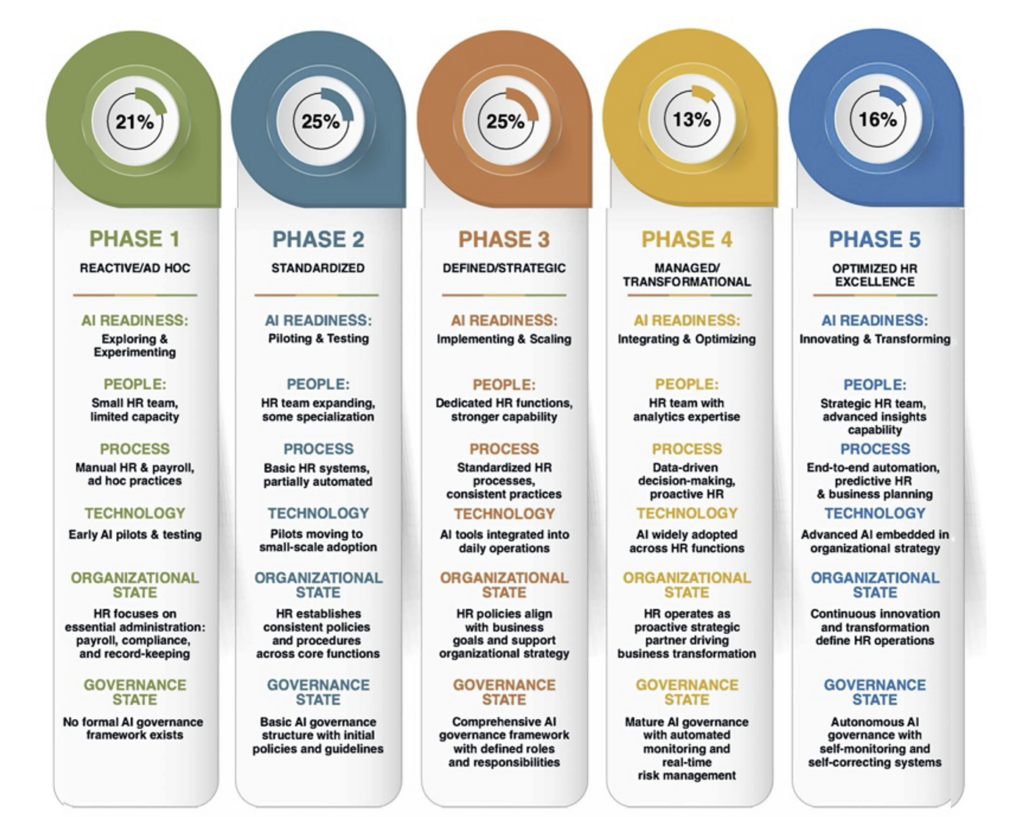
Organizations are at different stages of AI application. Our research with 1,000 organizations has shown that 46% of organizations are at the beginning of their journey.
Why is this important? The opportunity to transform the workplace with AI is directly connected to an organization’s readiness and stage of progression. The benefits of AI are clear but one out of two organizations are still understanding the impact of AI and are working through pilots to better understand how to use and govern AI in their organizations.
The opportunity to transform workforce readiness through AI is evident. Brandon Hall Group™ Excellence Award®️ winning organizations (organizations that are highly progressive in the use of AI) report that future capability building is a top three focus in their learning strategy needs.
AI is not just a technology for skills building and elevating workforce readiness. It is a fundamental rethink in how to approach work and the skills requirements needed by people vs. what can be accomplished using AI. The impact for the L&D and talent functions is a fundamental shift from enabling the development of the workforce to being the hub for workforce intelligence, driving workforce readiness and improving business performance.
Cornerstone’s Future
There are players in the market responding to the change in learning created by the AI disruption. Docebo, Absorb, Cypher learning, Arist and Workday’s Sana, along with a host of smaller nitch providers, are trying to flex and show they are harnessing the power of AI for their clients. SAP SuccessFactors and Oracle are also making significant investments in AI and bring a new and holistic approach to leveraging AI in skills development and building workforce capacity.
The market is not without advancements made by major LLMs and AI companion functionality in workforce technologies (Microsoft and Adobe).
Cornerstone is positioning itself at the center of one of the most important shifts happening in workforce technology: the move from traditional learning management systems to AI-powered workforce intelligence platforms. Rather than focusing solely on courses and compliance training, the company is redefining learning as a strategic business capability tied directly to workforce readiness, skills intelligence, organizational agility and long-term business transformation.
This evolution reflects a larger reality facing organizations today. Jobs are changing faster than ever, technical skills are becoming increasingly commoditized and the most valuable capabilities are shifting toward human judgment, adaptability, critical thinking, creativity and leadership. In this environment, companies can no longer rely on rigid career paths or static job descriptions. Career journeys are becoming more fluid, nontraditional talent backgrounds are gaining value and organizations must rethink how they identify, develop and deploy talent across the enterprise.
Cornerstone’s Workforce AI™ strategy is designed to address this challenge directly. At the core of the platform is an AI-powered skills graph that combines signals from people data, work outcomes, learning activity and workforce systems to create a dynamic understanding of employee capabilities. Importantly, the platform emphasizes “Human AI” AI-generated skills intelligence that is validated and refined by human input.
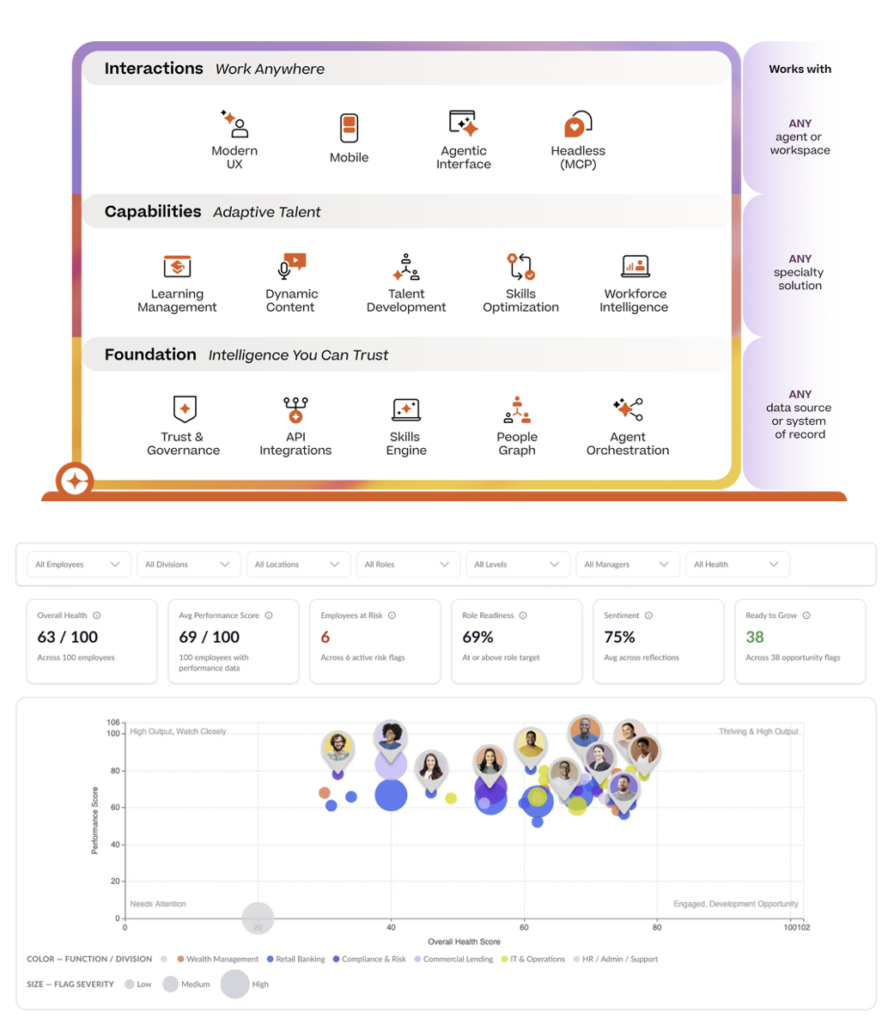
The company’s broader vision is that workforce systems should no longer operate in silos. Through Workforce AI™, Cornerstone is integrating data across HR systems, project management tools, engagement platforms, learning systems and external labor market intelligence with partners like Salesforce and AWS. The result is a unified workforce intelligence layer capable of identifying skills gaps, supporting internal mobility, accelerating onboarding, enabling proactive coaching and helping organizations align talent strategies directly to business needs.
Cornerstone has an impressive reach into data. Built on a world-leading workforce intelligence foundation.
- 28 TB of global labor market data ingested and processed daily
- 150T computations made against 1B profiles and 5B job roles
- 190+ countries tracked in daily labor market model updates
What makes this particularly compelling is that Cornerstone is not simply layering AI onto legacy systems. The company is fundamentally repositioning itself from an LMS provider into a workforce intelligence company. Executives acknowledged that traditional learning budgets and organizational structures are already beginning to shift, with AI-driven workforce discussions increasingly moving beyond the CLO and into conversations with CHROs, CIOs and CFOs. This reflects a growing belief that workforce readiness is now a core business issue rather than a standalone HR function.
The platform’s design also recognizes that the future workforce will require greater organizational speed and adaptability. AI-powered “Readiness Agents” such as the Internal Mobility Agent and Embark Navigator Agent are intended to help organizations place the right talent into the right work faster, personalize development at scale and respond more dynamically to changing business demands. Rather than relying on annual workforce planning exercises, organizations can begin operating with continuously evolving talent intelligence powered by real-time data and AI inference.
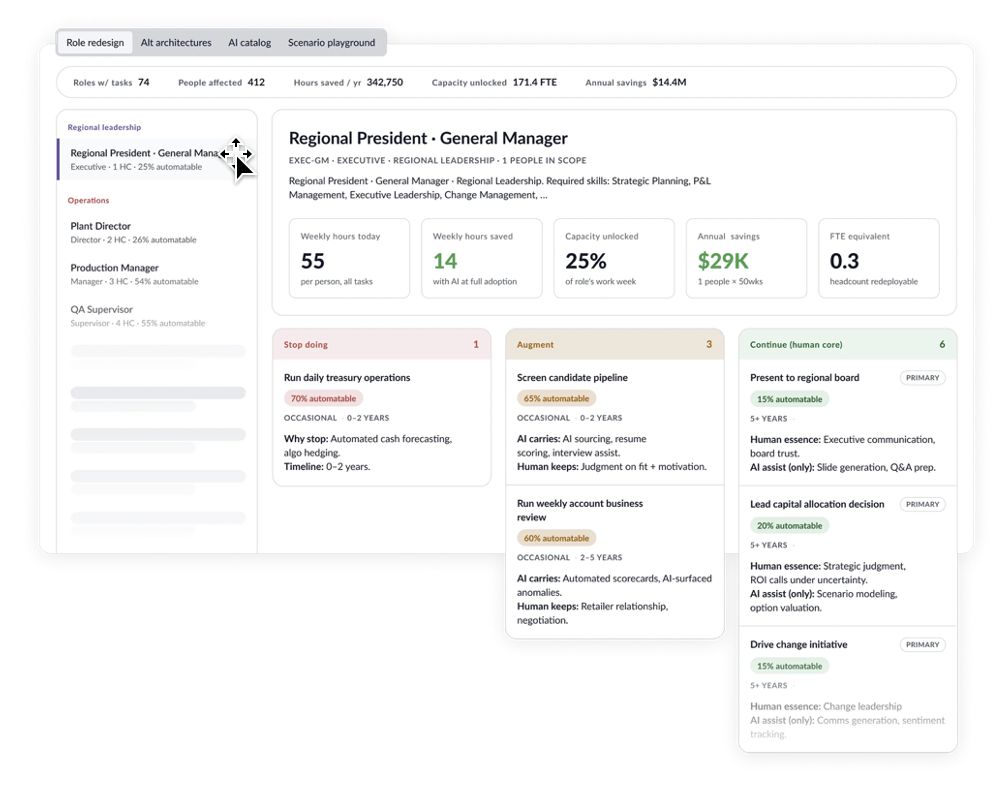
Examples shared during the Cornerstone Connect event reinforced how this strategy is already being applied in practice. Deloitte’s collaboration with Cisco demonstrated how AI-driven skills intelligence can help organizations identify workforce gaps, accelerate upskilling efforts and support more agile project-based staffing models. The discussion highlighted a growing need for organizations to move quickly while still ensuring humans remain central to decision-making. AI may surface patterns, recommendations and opportunities, but human leaders continue to provide the context, judgment and ethical oversight needed to guide workforce transformation effectively.
The broader implication is that organizations may need to rethink not only how they train employees, but also how they hire, develop and expose talent to leadership opportunities. Companies increasingly recognize that long-term competitive advantage will not come solely from technology investments, many of which may quickly become outdated, but from building adaptable, highly skilled people who can evolve alongside technology. As one theme throughout the event suggested, businesses do not transform themselves, humans transform businesses.
Cornerstone’s strategy reflects this balance between technology acceleration and human development. The company appears to recognize that while AI can dramatically improve workforce visibility, scalability and responsiveness, the lasting value still comes from enabling people to grow, adapt and contribute in more meaningful ways. In a market increasingly crowded with point solutions and AI experimentation, Cornerstone is attempting to differentiate itself by creating a unified workforce intelligence ecosystem designed to keep humans at the center of workforce transformation while leveraging AI to operate with greater speed, precision and agility.