For years, rewards and recognition has largely been viewed as an employee engagement program. Recognize people for great work, reinforce company values, celebrate important moments and hopefully create a stronger connection between employees and the organization.
That still matters. But our research suggests something much bigger is happening.
Recognition is evolving from a standalone engagement initiative into a continuous business system that can influence behavior, generate workforce intelligence and help organizations drive measurable business outcomes.
Over the past several months, Brandon Hall Group has explored this evolution through our research into the rewards and recognition market, an in-depth assessment of Achievers, conversations with Achievers leaders and a closer look at how recognition connects with some of the biggest workforce challenges organizations are facing today.
The conclusion is increasingly clear: At scale, recognition can tell organizations a tremendous amount about how work is actually happening.
Recognition Is Progressing Beyond the Traditional Program
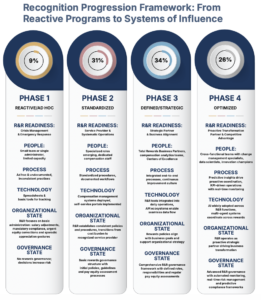
Our research identifies four stages of rewards and recognition progression: Reactive/Ad Hoc, Standardized, Defined/Strategic and Optimized.
Most organizations have moved beyond purely reactive recognition, but relatively few have reached the highest level of maturity. Only 26% of organizations are currently operating at the Optimized stage, where recognition becomes integrated into daily operations, supported by advanced technology and analytics, and connected directly to business priorities.
That distinction matters.
As organizations progress, recognition changes from something they do into something that becomes embedded in how the organization operates.
At the Defined/Strategic stage, recognition is aligned with business goals, supported by integrated processes and connected with other workforce systems. At the Optimized stage, organizations begin using AI, predictive insights and real-time data to understand and reinforce the behaviors driving performance.
This progression also changes the questions leaders should be asking.
It is no longer simply: Are our employees being recognized?
Organizations can begin asking: What behaviors are being recognized? Where are they happening? Which skills are showing up? Which teams are collaborating? Are employees demonstrating the values and behaviors our strategy requires? And what does that tell us about performance, retention and workforce readiness?
Recognition Data Can Become Workforce Intelligence
This is where our work with Achievers became particularly interesting.
Achievers operates across more than 600 customer organizations and millions of employees. Its scale of interaction creates something beyond a large recognition program. It creates a high-volume behavioral dataset.
Every recognition moment can capture signals related to performance, skills, collaboration and values alignment. Taken together, those interactions begin to provide a different view of the workforce.
Our research found, for example, that employees receiving consistent recognition are more than five times as likely to remain with their organization. Top-performing employees give and receive recognition at 2.2 times the average rate. Recognition can also reinforce learning and capability development, helping organizations connect development activity with behaviors employees actually demonstrate on the job.
This is why we believe recognition has the potential to become an important source of workforce intelligence.
Traditional HR data frequently tells leaders what has already happened. Surveys tell us what employees say or feel at a particular point in time. Recognition data can add another dimension: observed behaviors occurring continuously across the organization.
The value of recognition data is not simply that it gives organizations more information. The value comes when leaders can both interpret those signals and act on them. Recognition data can help managers see which behaviors are being reinforced, which employees may be functioning on the job without visibility or recognition, and where collaboration, connection or capability may be emerging within the company.
Recognition data becomes powerful when leaders use it to understand behavior and not just activity. The goal is not simply to know who was recognized, but to understand what work is being valued, where collaboration is flourishing and how those signals can help strengthen performance, culture and retention. In that sense, recognition becomes more of a leadership tool than simply a culture signal.
Explore the Research
Our Rewards and Recognition Platforms: The Achievers Edition Bellwether Report takes a deeper look at the rewards and recognition market, our Recognition Progression Framework, the Achievers platform, customer outcomes, AI innovation and the future of recognition as a workforce intelligence system.
Recognition Has to Live Where Work Happens
There is another important part of this evolution.
Organizations cannot create continuous behavioral signals if recognition remains another destination employees have to remember to visit.
Recognition increasingly needs to happen in the flow of work.
Our research into Achievers found deep integrations across collaboration and HR environments, including Microsoft Teams, Outlook, SharePoint, Viva and Workday. Recognition can occur where employees are already communicating and working rather than requiring them to continually switch context.
That integration matters for adoption, but the bigger implication is strategic.
When recognition becomes connected with performance management, learning, skills and other workforce systems, the resulting data no longer needs to remain isolated inside a recognition platform. It can become another source of insight into how people are working and where organizations may need to intervene.
The progression is ultimately about moving recognition closer to the work itself.
What Does More Mature Recognition Look Like?
We explored that question further in our webinar, Recognition as a Strategic Business Capability: Advancing from Program to Performance Driver.
The conversation examines what separates traditional recognition programs from more mature approaches and why integration, governance, analytics and scale increasingly determine the business impact organizations can generate from recognition.
More importantly, it explores what organizations can learn from the progression itself.
You don’t become an optimized organization simply by implementing more technology. The operating practices around the technology matter just as much.
Watch the webinar: Recognition as a Strategic Business Capability
Recognition May Also Have a Bigger Role in AI Adoption
Our conversations with Achievers also took us somewhere we didn’t necessarily start: AI transformation.
In Episode 329 of the Brandon Hall Group Excellence at Work podcast, Michael Rochelle sat down with David Bator, Managing Director of the Achievers Workforce Institute, to explore the connection between recognition, engagement and successful AI adoption.
Organizations are investing heavily in AI, but successful AI transformation ultimately requires people to change how they work.
That makes adoption a behavioral challenge as much as a technology challenge.
Organizations need employees to experiment with new tools, develop new capabilities, share knowledge, collaborate differently and adopt new ways of working. Leaders also need visibility into where those behaviors are occurring and where adoption may be struggling.
Recognition can provide a mechanism for reinforcing those behaviors.
That raises an interesting question for leaders: Could recognition be one of the most underused tools in the AI transformation playbook?
The conversation explores employee readiness for AI, behavior change at scale and why the human side of AI transformation may ultimately determine whether organizations realize the value of their technology investments.
Watch the conversation: The Connection Between Recognition, Engagement and Successful AI Adoption
AI Can Change Recognition Without Replacing What Makes It Human
The relationship works in both directions.
Recognition can help organizations reinforce the behaviors required for AI adoption, while AI can make recognition systems more intelligent.
Our research found that Achievers is applying AI across recognition, communication and analytics to improve both the quality of recognition interactions and the insight organizations can generate from the resulting data.
At the interaction level, AI can help employees create more meaningful recognition. At the analytical level, it can identify patterns across millions of interactions, helping organizations understand which behaviors are being reinforced, which teams are driving performance and how recognition may correlate with outcomes such as retention and productivity.
But there is an important line organizations need to understand.
The risk is not that AI enters recognition. It is that organizations use AI to make recognition faster without making it more meaningful.
The goal should not be to automate the human connection that makes recognition meaningful. It should be to use AI to make that connection more useful, more visible and more actionable.
What HR Leaders Should Be Thinking About
There are several implications we believe HR and business leaders should consider as recognition continues to evolve.
Move beyond participation as the primary measure of success. Adoption matters, but organizations should increasingly look at the behaviors being reinforced and how those behaviors connect with business priorities.
Connect recognition with the broader workforce ecosystem. Recognition becomes much more powerful when it is connected with learning, performance, skills, collaboration and the other systems where employees work.
Treat recognition data as a potential source of workforce intelligence. Recognition captures behavioral signals that traditional HR systems and employee surveys may not.
Use recognition intentionally during transformation. Whether an organization is implementing AI, building new capabilities or changing how work gets done, recognition can reinforce the behaviors required to make the transformation stick.
Preserve the human element. AI can improve recognition and make its data more actionable, but authenticity remains fundamental to why recognition works.
The Bigger Picture
Perhaps the most important takeaway from this body of work is that recognition is not simply changing how organizations acknowledge employees.
It is changing what recognition can produce.
Recognition creates interaction. Interaction creates data. Data creates insight. And when organizations act on that insight, they have another mechanism for influencing behavior and aligning people with business priorities.
That is a very different value proposition from the recognition programs many organizations have operated for years.
It also helps explain why the category is moving beyond engagement.
The future of recognition is increasingly connected to performance, workforce intelligence and an organization’s ability to translate strategy into the behaviors required to execute it.
Explore Achievers in TotalTech
For organizations evaluating rewards and recognition technology, Brandon Hall Group’s TotalTech HCM Vendor Selection Platform provides a deeper look at Achievers’ capabilities, market positioning and solution profile.
The Achievers Solution Provider Profile examines the company’s recognition and rewards platform, key modules and features, AI-powered capabilities, workforce intelligence and integrations, along with Brandon Hall Group’s analysis of where the solution fits in the market.
The profile also explores Achievers Intelligence, its flow-of-work and Workday integrations, and emerging agentic capabilities that turn behavioral recognition signals into enterprise action.
View the Achievers Solution Provider Profile in TotalTech
Continue Exploring
Read the Research
Rewards and Recognition Platforms: The Achievers Edition
Watch the Webinar
Recognition as a Strategic Business Capability: Advancing from Program to Performance Driver
Watch the Podcast
The Connection Between Recognition, Engagement and Successful AI Adoption
Achievers is a Brandon Hall Group Eminence Partner. Through the Eminence Program, Brandon Hall Group works with leading solution providers to examine emerging workforce challenges, technology innovation and the practices shaping the future of HR, Talent and Learning.