What isolved’s evolution tells us about the next stage of HR maturity
The AI conversation in HR is evolving.
Most organizations began their AI journey focused on productivity. They used AI to generate content, answer employee questions, summarize information and automate routine tasks.
The next challenge is different.
How do organizations govern, manage, measure and hold accountable AI systems that increasingly participate in workforce activities?
That question sits at the center of two recent announcements from isolved. The company introduced its new Workforce Capital Management (WCM) category and launched the isolved Connector for Claude, bringing HR, payroll and benefits capabilities directly into Anthropic’s AI platform.
Taken together, the announcements are less about adding another AI feature and more about redefining how organizations think about workforce management.
A Different View of AI in HR
In its announcement on Tuesday, isolved argues that many organizations are approaching AI as a software problem when it is increasingly becoming a workforce problem.
As CEO Michael Haske explained, “An AI agent isn’t software you install and forget. It’s much more like an employee. It needs to be onboarded, trained, mentored, managed and assisted by a human when its confidence score is low and offloaded when its job is done. In every other part of a business, we call that a workforce.”
That perspective is what led isolved to introduce Workforce Capital Management, which it defines as managing human workers and AI agents together under a single system of record with common governance, accountability and lifecycle management.
The concept builds on ideas outlined in Haske’s recent article, Workforce Capital Management: A Category We’re Built to Own, where he argues that organizations will soon need visibility into both human and agentic workers operating across the enterprise.
Meeting Employees Where They Already Work
The second announcement was the general availability of the isolved Connector for Claude.
Rather than requiring employees to navigate multiple portals and systems, the connector allows users to access approved HR, payroll and benefits information directly within Claude conversations. Employees can ask questions, retrieve information and complete approved actions through natural language.
This approach aligns with a broader trend Brandon Hall Group™ is seeing across HR technology: Organizations increasingly want HR experiences embedded within the flow of work rather than requiring employees to switch between disconnected systems.
Six AI Agents Focused on Outcomes
Perhaps the most interesting part of the announcement is isolved’s introduction of six autonomous AI agents designed around specific HR outcomes.
Rather than functioning as generic assistants, each agent is responsible for a defined business objective while maintaining human oversight.
- The Guardian monitors payroll runs in real time and flags potential issues before payroll closes, helping organizations reduce payroll errors.
- The Advisor guides employees through benefits enrollment based on individual needs and circumstances to improve enrollment accuracy and completion.
- The Signal identifies retention risks and surfaces potential employee flight concerns before valuable talent leaves the organization.
- The Orchestrator coordinates onboarding activities across systems to help ensure employees are prepared and productive on day one.
- The Watchdog tracks regulatory and compliance changes across jurisdictions and alerts organizations to emerging obligations.
- The Helper provides around-the-clock responses to routine HR questions, delivering answers instead of simply routing tickets.
Whether or not organizations adopt these specific agents, they provide a useful framework for how HR leaders can think about AI.
The most successful HR AI initiatives are increasingly focused on outcomes:
- Better hiring decisions
- Fewer payroll errors
- Improved compliance
- Stronger retention
- Faster onboarding
- Better employee experiences
The technology matters. The outcome matters more.
How This Connects to the Brandon Hall Group Human Resources Progression Model for HR Excellence
The timing of this announcement is particularly interesting when viewed through the lens of Brandon Hall Group’s Human Resources Progression Model for HR Excellence.
Our research found that only 17% of organizations have reached an optimized HR progression level where advanced AI, automated governance, predictive insights and agentic capabilities operate at scale. Meanwhile, 45% remain in the first two phases of HR progression.
What makes the Workforce Capital Management concept noteworthy is that it extends the conversation beyond AI tools and into workforce governance.
Brandon Hall Group’s Human Resources Progression Model shows that the organizations achieving the highest levels of HR progression are not simply adopting more technology. They are building the governance, analytics, oversight and operational frameworks needed to manage increasingly complex workforce ecosystems. As organizations progress toward optimized HR, AI becomes embedded in workflows, decision support, monitoring and increasingly autonomous processes.
From that perspective, Workforce Capital Management is an interesting development because it frames AI agents as workforce participants that require accountability, visibility, governance and human oversight rather than simply another layer of software.
What HR Leaders Should Be Watching
The bigger takeaway is not whether every organization needs AI agents today.
The bigger question is whether HR is prepared to become the function responsible for governing a blended workforce of people and AI.
As organizations move toward more advanced stages of maturity, AI governance, accountability, compliance monitoring and workforce orchestration become core HR responsibilities. Our research suggests these capabilities will increasingly separate high-performing organizations from those still operating with fragmented systems and reactive processes.
Workforce Capital Management may ultimately prove to be less about a new technology category and more about a new management challenge.
HR leaders should be paying attention.
Join Brandon Hall Group and isolved
These topics will be part of our upcoming webinar:
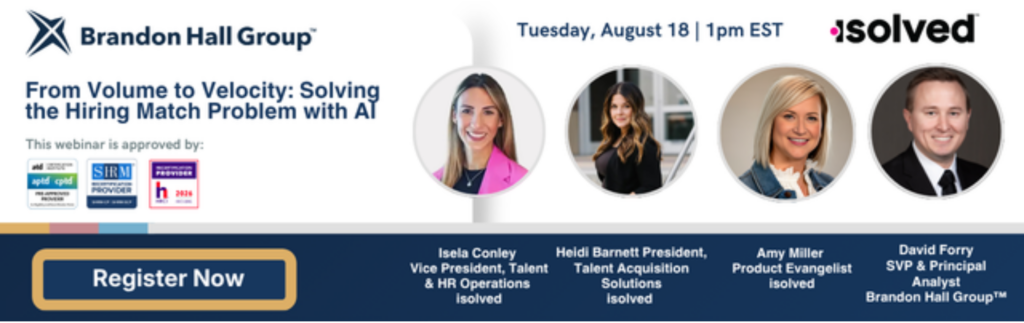
From Volume to Velocity: Solving the Hiring Match Problem with AI
Brandon Hall Group research finds that only one in five organizations consistently applies a standardized screening process. The challenge is often not candidate volume. It is candidate matching.
Join Amy Miller, David Forry, Isela Conley and Heidi Barnett as we discuss:
- How AI can improve sourcing, screening and candidate matching
- Ways to increase hiring velocity without sacrificing fairness
- Building governance into AI-supported hiring decisions
- Moving beyond resume-first hiring practices
- Improving recruiting outcomes through skills-based approaches
August 18, 2026 | 1:00 PM ET
Register here.