The Problem: The Static Architecture Trap
Most organizations built their talent systems for a world that no longer exists. That was one where job descriptions held steady for years, skill requirements shifted gradually and a two-year leadership development program could keep pace with the business. That world is gone.
Brandon Hall Group™ research reveals a sobering reality: 56% of organizations remain stuck in the earliest two phases of talent management maturity, operating with reactive or merely standardized approaches to workforce capability. Only 7% have reached optimized operations where talent management consistently drives competitive advantage. The gap between where organizations are and where volatility demands they be represents the single most consequential problem in human capital management today.
We call it the Static Architecture Trap, the condition in which talent systems are structurally designed for stability rather than the pace of capability change confronting the business. Processes designed for stability become liabilities in volatility. Organizations caught in this trap don’t just fall behind on skills; they lose the capacity to adapt at all.
This is the first installment in our six-part 2026 Volatility Research Perspective, examining how leading organizations are redesigning talent architecture from the ground up.
Five Design Principles for Volatility-Ready Talent Systems
Drawing on our Talent Management Progression Model for Empowering HR Excellence and analysis of award-winning talent management programs, Brandon Hall Group™ identifies five design principles that distinguish organizations capable of thriving through continuous change.
- Strategic Integration Over Administrative Alignment. Talent architecture must function as an integrated business system, not an HR program running alongside the business. Our research found that every award-winning organization demonstrated direct connections between talent initiatives and business priorities. In practice, this means workforce planning originates from business strategy conversations, not from job requisitions after strategy has already been set. Organizations at the highest maturity levels deploy predictive workforce forecasting that anticipates capability requirements across multiple business scenarios, enabling faster speed to capability building.
- Continuous Capability Sensing. Static, annual skill assessments cannot support dynamic talent architecture. Volatility-ready organizations implement continuous feedback loops, combining real-time performance data, peer and mentor input, and AI-driven skill mapping, to maintain a living picture of organizational capability. Our research shows that 64% of award-winning organizations have adopted goal-setting processes with cascading alignment, and 43% use 360-degree feedback systems. But the differentiator at the highest maturity tier is moving beyond periodic assessment events to embedded, continuous capability validation through work observation and performance analytics.
- Personalized, Modular Development Pathways. One-size-fits-all development programs cannot keep pace with rapidly diverging skill requirements. Brandon Hall Group™ research confirms that 64% of high-performing organizations implement leadership development programs and 50% create individual development plans but the leading edge goes further, deploying personalized career navigation tools, modular microlearning and AI-powered recommendations that adapt to each employee’s current capability profile, career aspirations and the organization’s evolving needs. The development architecture must be composable: capable of being assembled, reassembled, and personalized in real time.
- Collaborative Knowledge Networks. In volatile environments, knowledge concentrated in individuals or static repositories becomes a critical vulnerability. Award-winning organizations build structured mentoring programs (57% prevalence), coaching systems (43%), and cross-functional project assignments (29%) that distribute knowledge across the organization. The most advanced organizations treat knowledge transfer as a continuous, networked process rather than an event, using collaborative learning cohorts, peer feedback and structured mentoring relationships to ensure institutional knowledge flows freely and new capabilities propagate rapidly.
- Adaptive Technology Ecosystems. Technology must enable, not constrain, the speed of organizational adaptation. Our data shows that 64% of award-winning organizations have implemented comprehensive learning management systems, with advanced implementations adding AI-powered tools (22%), real-time dashboards (36%) and scenario-based practice environments. However, the defining characteristic at the highest maturity level is technology that doesn’t just deliver content but orchestrates entire talent ecosystems: connecting learning, mentoring, practice, assessment, and career pathing on integrated platforms that adapt as business conditions change.
The Volatility Readiness Maturity Model: Reactive — Integrated — Adaptive
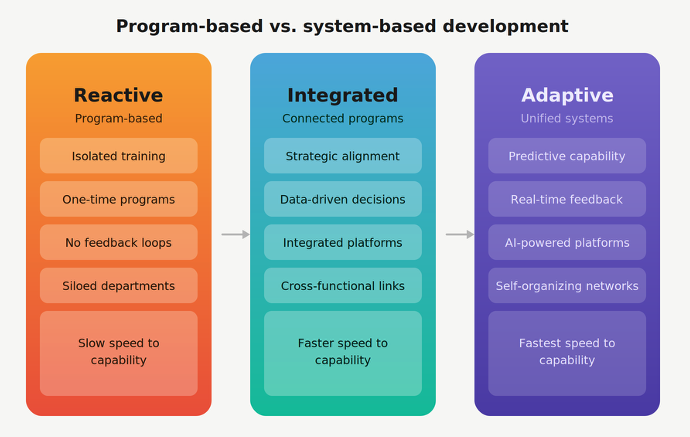
Based on our four-phase Talent Management Progression Model and evidence from award-winning organizations, Brandon Hall Group™ has developed a three-tier Volatility Readiness framework to help organizations diagnose where they stand.
Tier 1: Reactive. Talent activities are crisis-driven and administratively focused. Hiring fills immediate vacancies. Development is generic and sporadic. Succession planning, if it exists, consists of emergency replacement lists. Technology relies on spreadsheets and disconnected systems. Knowledge lives in individual heads. Brandon Hall Group™ research places roughly 56% of organizations in this band (encompassing Phase 1 and Phase 2 of our Progression Model). These organizations are structurally unable to anticipate or respond to rapid change; they can only react after the gap has already damaged performance.
Tier 2: Integrated. Talent management achieves strategic alignment with the business. Data-driven decision-making becomes standard practice. Succession pipelines are actively developed. Integrated technology platforms connect performance, learning and career functions. Assessment is comprehensive and multi-source. This corresponds to Phase 3 (Defined/Strategic) of our Progression Model, where 37% of organizations operate. Integrated organizations can respond effectively to change but still depend on human coordination to detect and adapt to new conditions.
Tier 3: Adaptive. Talent systems proactively anticipate and adjust to change. Predictive analytics forecast capability requirements before gaps materialize. AI-powered platforms deliver personalized development at scale, connecting learning, mentoring and practice in continuous loops. Knowledge networks self-organize around emerging needs. Development pathways reconfigure dynamically. Only 7% of organizations currently operate at this level but they represent the model for volatility readiness. These organizations don’t just respond to change; they are architecturally designed to absorb it continuously.
Where Does Your Organization Stand?
Ask yourself three diagnostic questions:
- When your business strategy shifts, how quickly can your talent system reconfigure development priorities: days, months, or never? Reactive organizations may take quarters or longer. Adaptive organizations reconfigure in weeks or days because their architecture was built for it.
- Can you see your organization’s real-time capability landscape: Who can do what, who is developing toward what and where the gaps are emerging? Reactive organizations rely on manager intuition. Adaptive organizations have living, data-driven capability maps continuously updated through integrated technology.
- Does your development architecture connect learning, practice, mentoring and feedback into a single continuous experience, or do these exist as separate programs? Reactive organizations run isolated training events. Adaptive organizations operate integrated ecosystems where every development interaction reinforces the others.
If your answers land mostly in the Reactive category, you are caught in the Static Architecture Trap. If you are Integrated, you have the foundation but volatility will outpace coordination-dependent systems. If you are Adaptive, you are among the 7% positioned for sustained competitive advantage through talent.
Building Toward Adaptive: Where Technology Makes the Difference
Reaching the Adaptive tier requires technology platforms purpose-built for continuous change — platforms that integrate learning, collaborative practice, mentoring, and AI-driven personalization in a single ecosystem rather than bolting together disconnected point solutions. NovoEd is one example of a platform exemplifying Adaptive-tier capabilities: its integrated Learn+, Mentor+ and Practice+ products create the kind of continuous development loop, combining cohort-based collaborative learning, structured mentoring relationships and scenario-based skill practice with AI-enabled personalization that enables organizations to develop talent at the speed the business demands. NovoEd is a Brandon Hall Group™ Diamond Smartchoice® Preferred Provider.
The architecture matters. Organizations that invest in Adaptive-tier infrastructure don’t just develop skills faster. They build the organizational capacity to keep developing skills faster, no matter what changes next.