What the RocketReach, HireQuotient and Paylocity Ecosystem Signals for Talent Leaders
As Brandon Hall Group deepens its investment in the Talent Acquisition space, one announcement caught our attention yesterday. RocketReach, HireQuotient and Paylocity are expanding their partnership even further.
Why is that interesting?
What if the next competitive advantage in Talent Acquisition is not another recruiting tool, but the ability to connect intelligence, technology and agentic workflows into one ecosystem that continuously finds, engages and converts the talent the business needs? That is the shift leading organizations should be watching. The opportunity is no longer simply to automate individual recruiting tasks. It is to create a connected TA environment where data and intelligence move across sourcing, assessment, engagement, hiring and broader workforce decisions.
For recruiting leaders, that means less time managing disconnected technology and more time improving quality of hire, candidate experience, speed and business impact. This is where the TA technology market appears to be heading, and it raises an important question for every organization: Are you building a recruiting tech stack, or a connected talent intelligence ecosystem?
Frontline recruiting has long operated with an uncomfortable contradiction. The roles are essential, but the systems supporting them are often fragmented. Recruiters move between job boards, spreadsheets, contact databases, screening tools and core HR platforms. Candidates repeat information across applications and interviews. Credentials are checked late. Outreach is broad, response rates are uneven and hiring teams spend too much time on administrative work.
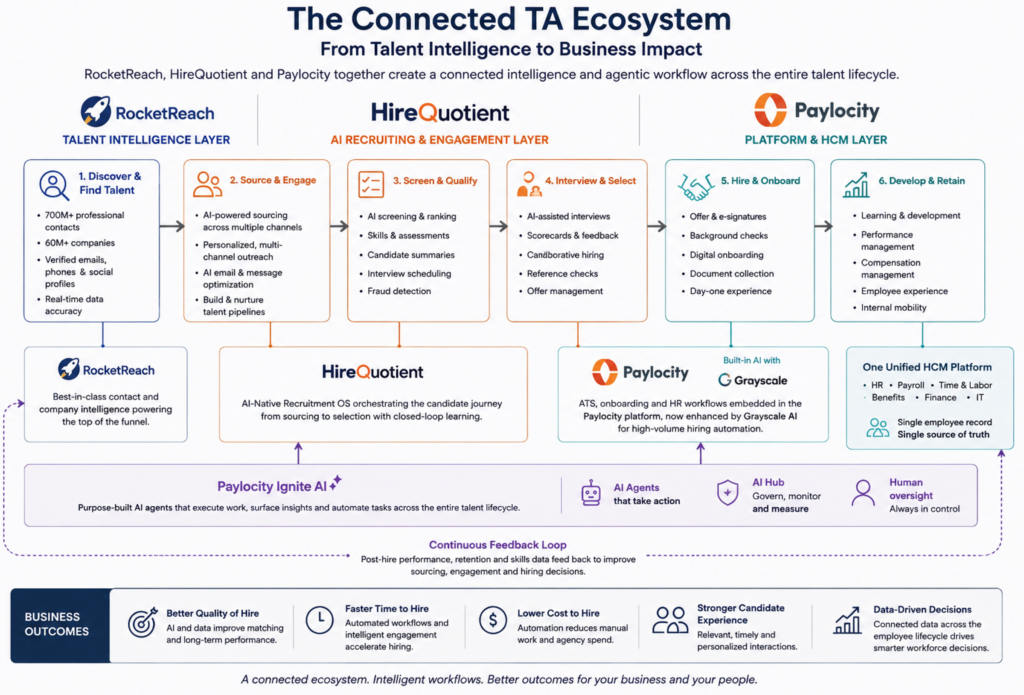
The expanding relationship among RocketReach, HireQuotient and Paylocity offers a useful view of how the market is trying to solve that problem and just another in a long list of technologies combining to offer a singular solution that can work together, faster, in one place, and build long term intelligence for organizations. RocketReach contributes professional and contact data. HireQuotient applies AI to sourcing, screening, outreach and assessment. Paylocity places those capabilities closer to the systems already used by midmarket employers. Together, the three companies represent an emerging model in which specialized technologies connect to create a more complete hiring workflow.
A Partnership That Has Been Building
This is not an entirely new relationship. RocketReach and HireQuotient announced a data partnership in August 2024, initially emphasizing healthcare recruiting. RocketReach’s contact intelligence has since supported HireQuotient’s EasySource platform, helping recruiters identify candidates and reach them through more complete contact information.
The more recent development is distribution. HireQuotient announced an integration with Paylocity in July 2026, bringing its AI supported sourcing and screening capabilities into Paylocity’s ecosystem. RocketReach then framed the expanded relationship as an entry point into midmarket HR and frontline recruiting. The target sectors include healthcare, insurance, construction, manufacturing, logistics, hospitality and building services.
That combination matters because each participant fills a different layer:
- RocketReach: Professional profiles, email addresses, telephone numbers and company intelligence that support candidate discovery and engagement.
- HireQuotient: AI assisted sourcing, license verification, screening, personalized outreach, interviewing and workflow orchestration.
- Paylocity: Access to an established midmarket customer ecosystem and a connection to the HR and recruiting environment where work is already managed.
Why Frontline Hiring Needs a Different Approach
Many frontline roles combine high hiring volume with highly specific requirements. A healthcare employer may need to confirm a clinical license before investing recruiter time. An insurance employer may need to validate state licensing. A manufacturer may need to identify shift availability, location, safety experience or technical certifications. Traditional keyword searches and generic application workflows often struggle to represent these requirements accurately.
HireQuotient says its platform can verify credentials against sources such as NPI, NIPR and state registries. If implemented effectively, that could move validation earlier in the process, reduce avoidable screening and help recruiters focus on qualified candidates. RocketReach’s contact data can then support direct outreach, while Paylocity can provide a more connected route into the employer’s existing workflow.
The broader implication is important: frontline hiring technology is shifting from isolated automation toward coordinated decision support. The value does not come from one more AI feature. It comes from connecting candidate intelligence, qualification evidence, engagement and workflow execution around a defined hiring outcome.
A Promising Model, With Claims Still to Validate
The companies are presenting compelling outcome claims. HireQuotient says the Paylocity integration can reduce time to hire by as much as 70% and save a midmarket employer approximately $100,000 annually. A cited customer, Alliance Building Services, reportedly reduced time to close positions by more than 60%. These figures suggest potential, but time will tell.
Talent leaders should also recognize that this is an ecosystem of companies at very different stages. Paylocity is an established public HR technology provider. RocketReach has a large global user base and a mature contact intelligence business. HireQuotient is a much smaller, emerging vendor. Its product ambition is broad relative to its current scale. That is not necessarily a weakness. Smaller providers can innovate quickly and focus intensely on underserved workflows. It does, however, make implementation capacity, customer support, integration reliability, security practices and product maturity important parts of any evaluation.
Import Notes for TA
Integrated ecosystem ≠ single suite
For years, organizations have faced what seemed like a binary choice in TA technology: buy an integrated suite or assemble best-of-breed point solutions. Agentic AI and increasingly sophisticated integrations are beginning to challenge that choice.
A single suite attempts to provide most of the capabilities an organization needs within one vendor’s platform. The advantages are familiar: fewer vendors, common data structures, simpler administration and potentially a more consistent user experience. The tradeoff is that the organization may accept “good enough” functionality in certain areas in exchange for integration and simplicity.
An integrated ecosystem is different. Organizations can potentially select specialized technologies for particular capabilities, such as talent intelligence, sourcing, assessment, candidate engagement or interviewing, while connecting those technologies to an HCM or TA platform that serves as the system of record.
The future of Talent Acquisition may not belong exclusively to the single suite or the best-of-breed point solution. It may belong to the best-connected ecosystem.
Five Questions Talent Leaders Should Ask
- How accurate and current is the underlying data?
Candidate contact information, employment records and credentials change. Employers should understand verification frequency, confidence scoring, correction processes and what happens when sources disagree.
- Where does automation stop and human judgment begin?
AI can prioritize and summarize, but recruiters and hiring managers remain accountable for job relevance, fair treatment and final decisions. Buyers should be able to inspect, edit and override system recommendations.
- Does the integration remove work or merely relocate it?
A credible pilot should measure recruiter steps, duplicate data entry, handoffs, exception handling and time spent inside each system.
- What is the candidate experience?
Personalized outreach can improve engagement, but excessive automation can feel intrusive. Organizations should test message quality, consent practices, response handling, accessibility and escalation to a person.
- Which outcomes will prove value?
Time to hire is useful but incomplete. Quality of slate, credential accuracy, interview conversion, new hire performance, retention, recruiter capacity and candidate satisfaction provide a more balanced view.
What This Signals for the Market
The partnership reflects a larger change in HR technology. Buyers increasingly expect intelligence to appear inside the systems where recruiters already work. Data providers are becoming embedded infrastructure. Specialized AI platforms are seeking distribution through established HR ecosystems. Many core platforms are expanding capability through partners rather than building every function themselves.
For frontline employers, this model could be especially valuable. Their hiring challenges are often urgent, geographically distributed and constrained by licensing, availability and labor supply. A connected workflow could shorten the distance between identifying a candidate and determining whether that person is ready to move forward.
But integration alone does not create transformation. The real test will be whether employers can produce better slates, verify qualifications earlier, improve recruiter productivity and give candidates a clearer experience without introducing new risks or opaque decisions. That requires disciplined implementation and independent measurement.
The Bottom Line
RocketReach, HireQuotient and Paylocity illustrate a credible direction for the future of frontline hiring: verified data feeding intelligent workflows that operate within an established HR ecosystem. The proposition is attractive because it addresses the fragmentation that has constrained frontline recruiting for years.
The opportunity is real, but so is the need for careful evaluation. Talent leaders should look beyond feature breadth and headline efficiency claims. The strongest business case will come from verified data quality, transparent decision support, responsible candidate engagement, reliable integration and measurable workforce outcomes. If the ecosystem can deliver those elements consistently, it could offer more than faster recruiting. It could help make frontline hiring a more precise, connected and sustainable business capability.
However, organizations should still evaluate functionality, cost, usability and implementation. But they also need to consider interoperability, data portability, orchestration, agent-to-agent interaction, governance, security, workflow continuity and the ability to feed business outcomes back into talent decisions.