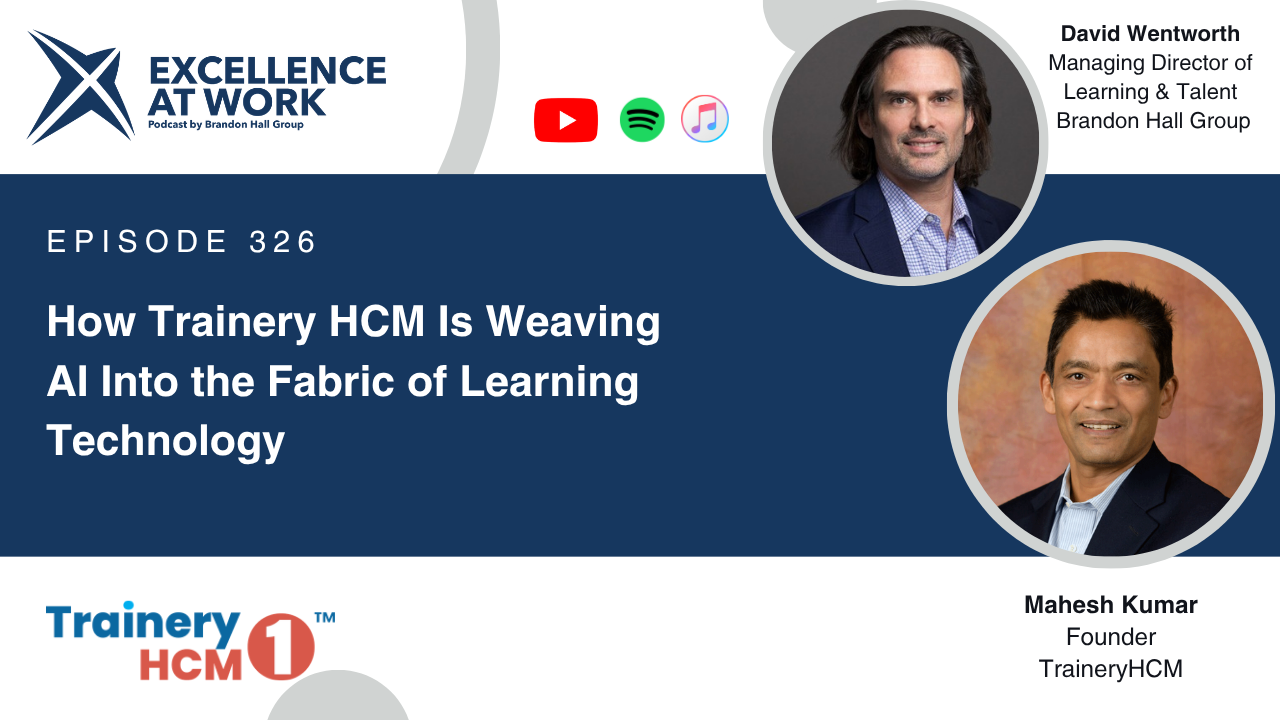
In this episode of the Brandon Hall Group™ Excellence at Work podcast, host, David Wentworth, Managing Director of Learning and Talent, Brandon Hall Group, sits down with Mahesh Kumar, Founder of TraineryHCM, for a wide-ranging conversation that is equal parts origin story and industry forecast. Mahesh brings an unconventional lens to the world of HR technology, one shaped by over two decades on Wall Street across three continents. What emerged from that career was not a planned pivot into SaaS, but what Mahesh himself calls an “accidental” one. The result is a company built with the sensibilities of an enterprise operator: obsessed with scalability, skeptical of hype, and relentlessly focused on client outcomes. This conversation covers how TraineryHCM came to be, what scalability really means in today’s learning technology landscape, and how Mahesh is thinking about AI, not as a feature to bolt on, but as something to weave into the fabric of a product.
To read the Executive Interview with Mahesh Kumar, click here.
Key Topics
- From Wall Street to accidental SaaS founder, and why that background matters: Mahesh did not set out to build a software company. After two decades at some of the world’s largest financial institutions, acquired a consulting firm, and eventually acquired a content company called Training Network, from which TraineryHCM was born. Far from making his background irrelevant, that Wall Street experience gave him three things that directly shape how he builds: a deep intuition for enterprise-grade scalability, a rigorous approach to project and process management, and a go-to-market sensibility earned by watching how large organizations operate at scale. Some of what he learned does not apply to a startup. But knowing how to scale a product, a team, and an offering, and that travels anywhere.
- Scalability is not about headcount, it is about reducing friction as complexity grows: One of the most clarifying moments in the conversation is Mahesh’s reframe of what scalability actually means. For most people, it conjures images of servers handling millions of users. For Mahesh, it is something more fundamental: the ability to add organizational complexity, operational breadth, and user volume without a corresponding increase in friction. He breaks this down into three pillars. The first is organizational, covering multi-entity structures, role-based access, and governance that actually works at scale. The second is operational, focused on replacing manual coordination with governed workflows that improve efficiency rather than create bottlenecks. The third, and perhaps most important, is user experience. If a system requires training to use, it will struggle to scale. The benchmark Mahesh uses: a brand new user should be able to come in and operate the system effectively without hand-holding. That is what true scalability looks like.
- An AI philosophy built around client benefit, not product marketing: When AI arrived, TraineryHCM made a deliberate choice: do not just bolt it on. For established players with large legacy architectures, that is often the only option, a fast-follow feature set wrapped around a system not built for it. As a smaller, more agile company, Trainery had the ability to re-architect and weave AI directly into the product. That re-architecting was expensive and disruptive, but it meant AI became part of how the product works, not an add-on that works alongside it. More importantly, the internal strategy question was never “how do we add AI?” It was: “how does this benefit the client?” For every module and function, the team asked what value AI could create, what guardrails were needed, and whether clients, including regulated financial institutions with strict compliance requirements, could turn it on or off. A concrete example: AI-powered job description management that transforms a painful manual migration from folder-based systems into an automated, seamless experience. Start with the client problem. Let the AI serve the solution.
- Hard-earned lessons: digitize your relationships, and learn to say no to clients: Mahesh is candid about the mistakes made along the way. Two stand out. The first: Trainery had deep, longstanding relationships with content producers and developers, but failed for too long to translate those relationships into a digital, scalable solution. The legacy of how those relationships operated held back what was possible. By the time the team recognized the gap, they had lost ground they could have held. The lesson: do not let the weight of how you have always done something prevent you from building what clients actually need. The second lesson is one that will resonate with any technology provider who has ever landed a large logo: saying yes to everything a big client asks for is a trap. When you build to the specific demands of one organization, you risk creating something that does not generalize, and you divert resources away from what the broader market actually needs. A little market analysis, Mahesh reflects, goes a long way toward knowing when to push back.
- Skills in the age of AI, and the BC/AC divide: The conversation closes on one of the most discussed topics in talent today: skills. Mahesh’s framing is clear-eyed and a little sobering. The baseline technology fluency required to get and hold a meaningful job is rising fast, and AI is accelerating that rise. His CTO put it memorably: February 6th marks the dividing line between BC (Before Claude) and AC (After Claude), and the workers hired hired before that date have had to fundamentally transform how they work. Productivity expectations are higher, fewer people are being hired to do the same volume of work, and the premium on what makes a human uniquely valuable has never been greater. David and Mahesh explore the parallel to the smartphone era, a technology that was once debated and restricted, then absorbed so completely it became invisible. AI is on the same trajectory. The question is not whether to use it. The question is whether you are developing the distinctly human skills that make you irreplaceable once you do.