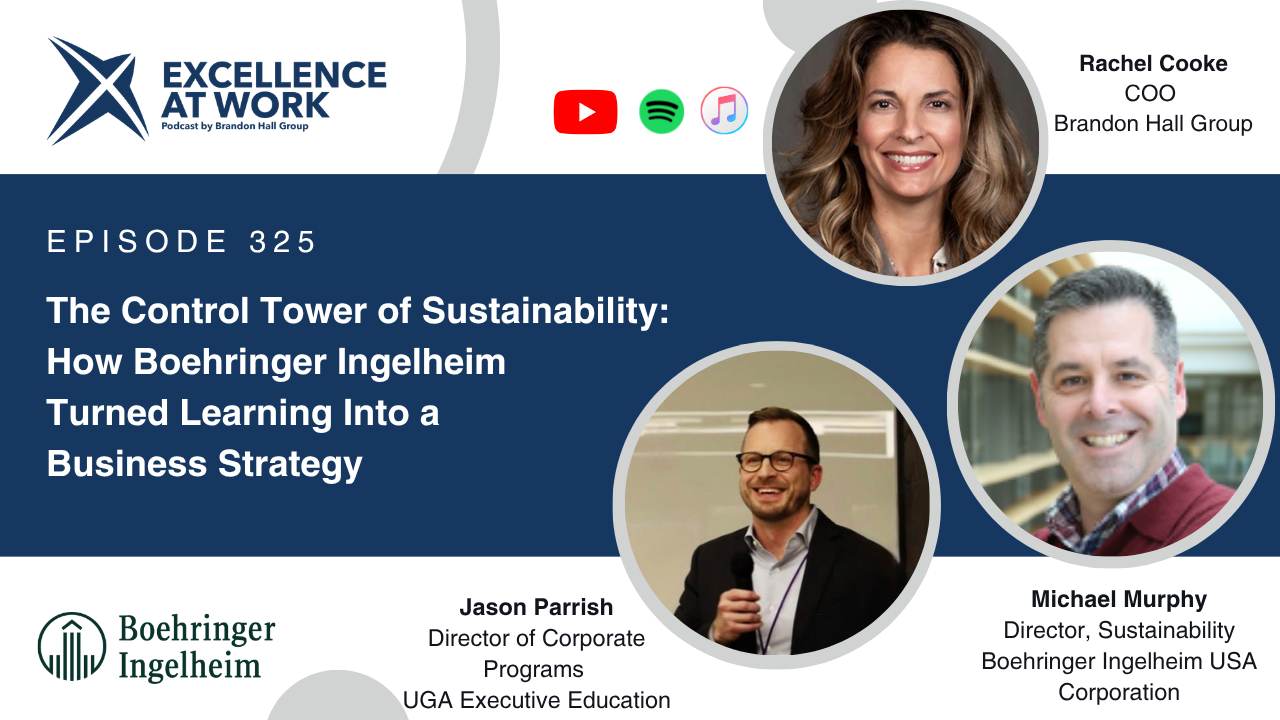
In this Brandon Hall Group™ Excellence at Work Podcast, Rachel Cooke, Chief Operating Officer at Brandon Hall Group, Michael Murphy, Director of the U.S. Office of Sustainable Development for Generations at Boehringer Ingelheim, and Jason Parrish, Director of Corporate Programs at UGA Executive Education, explore how Boehringer Ingelheim’s award-winning Sustainable Development Excellence (SDX) program is building a culture of sustainability from the inside out, and why the best solutions to the world’s biggest challenges are built through partnership.
To read the Executive Interview with Michael Murphy and Jason Parrish, click here.
Key Discussion Points:
- A Corporate Priority Turned Cultural Movement: Sustainability at Boehringer Ingelheim is not a side initiative. It is tied directly to the company’s commitment to the United Nations Sustainability Goals with a 2030 deadline, as well as its identity as a fourth-generation privately held company focused on building for the future. The SDX program was created to educate and activate the organization’s 8,500 U.S. employees around that mission.
- Three Pillars, One Program: The SDX curriculum is structured around Boehringer Ingelheim’s three strategic sustainability priorities: More Green, focused on environmental health; More Health, focused on expanding access to care for vulnerable communities; and More Potential, focused on building healthy communities through external partnerships. Every module maps back to one of these pillars, keeping the learning tightly aligned to business strategy.
- A Hybrid Design Built for Real Impact: The program combines in-person classroom learning, synchronous and self-paced virtual learning, and a capstone project, making it one of the most comprehensive designs UGA Executive Education has delivered. Participants self-nominate at all levels of the organization, and each cohort commits to 80 hours of service toward a sustainability goal during and after the program.
- The Leader Teacher Model Sets It Apart: One of the most distinctive elements of the SDX program is its co-delivery model. A UGA faculty member covers theory while a Boehringer Ingelheim leader teacher brings it to life with real company examples. Participants consistently say this dual approach gives them both the foundational knowledge and the practical context to take action, understanding not just what carbon neutrality means but exactly what Boehringer Ingelheim is doing to achieve it.
- ROI in the Millions: The program consistently scores between 4.7 and 4.8 out of 5 on content and delivery quality, with a Net Promoter Score in the 80th percentile or higher. More impressively, capstone projects have generated cost savings opportunities in the millions of dollars, delivering a tenfold return on the program investment. Graduates also average 140 employee touchpoints each through their ongoing service requirements, creating a ripple effect of activation across the organization.
- Capstone Projects Go Beyond the Classroom: What makes the capstone component truly unique is that projects are both internal and external. In addition to solving business challenges within Boehringer Ingelheim’s human and animal health divisions, participants take on consultative projects for nonprofit partners in the community, applying skills-based volunteerism to real sustainability problems at no cost to those organizations.
- Building Capability Until It Becomes DNA: Michael’s vision for the SDX program is to eventually make his own function unnecessary. The goal is not to run programs indefinitely but to build sustainability capability so deeply into the organization that it becomes part of how every employee works and thinks. Graduates are already proving this out, including conceiving and building an internal equipment marketplace that reduces waste and saves costs across labs.
- Clarity and Shared Values Make the Partnership Work: Jason’s advice to any organization considering a similar initiative is to start with a clear vision and then find a partner who genuinely shares it. Boehringer Ingelheim came to UGA knowing exactly what they wanted to accomplish. That clarity made it possible to draw from faculty expertise across the entire university and deliver something truly differentiated.
- Scaling Globally, One Region at a Time: The program is already expanding beyond the U.S., with participants from Canada, Mexico, South America, Brazil, and the United Kingdom joining or expressing interest. Boehringer Ingelheim is being intentional about geographic proximity to manage travel demands while continuing to broaden the invitation.
The conversation is a powerful reminder that sustainability is not a compliance exercise. When it is embedded in business strategy, co-designed with the right partners, and activated through people who genuinely care, it becomes a capability that outlasts any program. Boehringer Ingelheim and UGA Executive Education have built something worth sharing, and as Michael put it, solving the world’s sustainability challenges is something no company can do alone.