For decades, SAP has been one of the foundational enterprise software providers powering global business operations across finance, supply chain, manufacturing, inventory planning, procurement, human capital management (HCM) and more. Historically, SAP’s strength has been its ability to centralize and standardize mission-critical enterprise processes for some of the world’s largest organizations.
What makes the Sapphire 2026 announcements so significant is that SAP is no longer simply modernizing enterprise software; it is redefining how enterprise work itself is executed. The shift toward the Autonomous Enterprise signals a major evolution from systems of record and workflow automation into AI-driven operational orchestration with human oversight. With Joule (SAP’s enterprise AI copilot and orchestration layer), autonomous agents, SmartRecruiters integration and intelligent workforce coordination, SAP is positioning itself at the center of the next generation of enterprise transformation.
Because SAP supports a massive portion of the global enterprise economy, these announcements extend far beyond traditional HR technology changes. They have the potential to influence how organizations approach workforce planning, recruiting, employee services, operational efficiency and AI governance for years to come.
For HR and talent leaders, the announcements surrounding SAP SuccessFactors may represent one of the most important strategic pivots the company has made in years. During a recent analyst briefing coordinated by Lindsay Stril and the SAP SuccessFactors Analyst Relations team and delivered by SuccessFactors CMO Lara Albert, we were given deeper insight into both the strategy and rollout plans behind SAP’s evolving Autonomous Enterprise vision.
SAP Is Reimagining HCM Around Autonomous Work
Historically, HCM systems have functioned primarily as systems of record. SAP is now pushing SuccessFactors toward becoming a system of intelligent orchestration.
At the center of this strategy is Joule, which is rapidly evolving from a conversational assistant into what SAP describes as a new “engagement layer” for enterprise work.
Rather than requiring users to navigate multiple applications and workflows, SAP’s new model allows employees, managers, recruiters and HR teams to interact with systems through natural language and AI-guided actions.
SAP announced more than 50 domain-specific Joule Assistants orchestrating over 200 specialized AI agents across finance, HR, procurement, supply chain and customer operations.
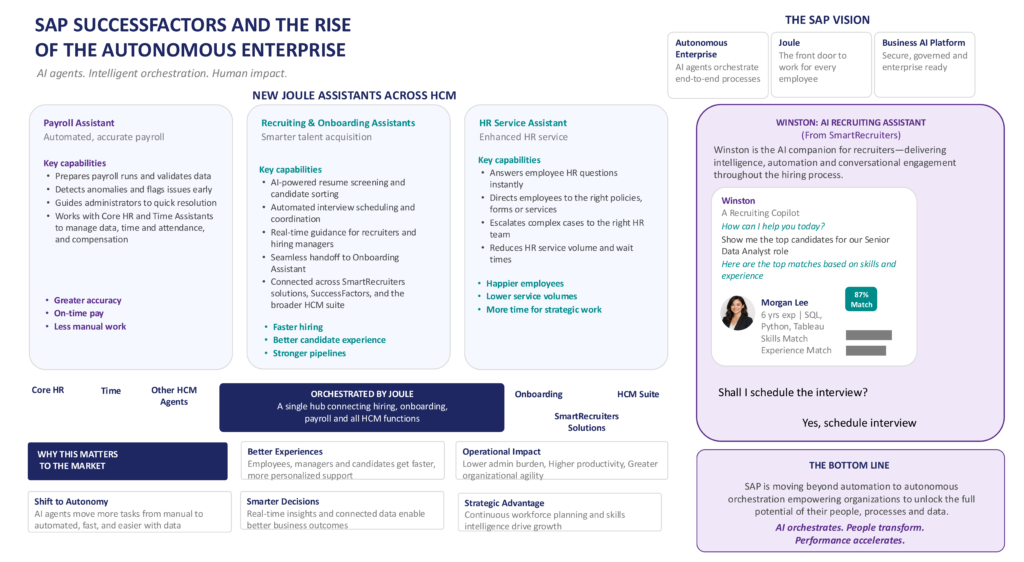
For HCM specifically, SAP introduced a series of new Joule Assistants within SuccessFactors designed to automate and coordinate end-to-end workforce processes.
The focus is not simply automation. SAP is aiming to reduce administrative friction, enabling HR teams to spend more time on workforce strategy, skills, leadership development and organizational planning.
The Rise of Autonomous HCM
One of the strongest themes from Sapphire was SAP’s push toward “Autonomous HCM.”
SAP SuccessFactors is positioning AI agents as active participants in business processes capable of surfacing insights, coordinating tasks, identifying risks and helping execute operational work.
Most organizations today still operate with fragmented HR systems, disconnected workforce planning and manually intensive recruiting and service processes. SAP’s vision attempts to unify these experiences through connected data, embedded AI and workflow intelligence.
A particularly important development is SAP’s workforce planning capability within SAP Enterprise Planning, which connects HR, finance, contingent labor and operational data into a unified planning model.
At Brandon Hall Group™, we continue to see the HR industry shifting quickly to workforce planning becoming a continuous strategic discipline rather than an annual HR exercise.
SmartRecruiters and “Winston” Expand SAP’s Talent Acquisition Strategy
Another major development is SAP’s expanding integration of SmartRecruiters into the SuccessFactors ecosystem.
Following SAP’s 2025 acquisition of SmartRecruiters, the company is increasingly positioning it as the future foundation of SAP recruiting.
At Sapphire and in related product updates, SAP highlighted deeper integrations between SmartRecruiters and SuccessFactors, including:
- Native HCM synchronization
- Single sign-on experiences
- AI-powered candidate matching
- Automated interview scheduling
- Conversational recruiting workflows
A particularly interesting addition is Winston, SmartRecruiters’ AI-powered recruiting intelligence layer.
Winston introduces capabilities such as:
- Resume-based job matching
- Conversational candidate engagement
- Match subscores for skills and experience
- AI-assisted recruiter Q&A
- Automated self-scheduling workflows
In practical terms, this could help organizations reduce hiring friction while creating more connected onboarding and workforce planning experiences.
Joule Becomes the Front Door to Enterprise Work
Perhaps the most important long-term takeaway from Sapphire is how SAP is repositioning Joule.
SAP is positioning Joule as the operational engagement layer for enterprise work itself, a substantial evolution in how employees interact with enterprise systems. The company also announced plans for 15 new HR-focused Joule Assistants in 2026.
Instead of users adapting to systems, systems increasingly adapt to users through conversational AI, contextual awareness and autonomous task execution.
SAP’s broader Autonomous Enterprise vision combines:
- SAP Business AI Platform
- SAP Autonomous Suite
- Joule Work
Together, these components aim to create an environment where AI agents can reason, recommend, coordinate and execute work inside governed enterprise processes.
The emphasis on governance and enterprise-grade reliability is also notable. SAP repeatedly stressed that mission-critical business operations require trustworthy AI grounded in enterprise data, compliance controls and operational context.
Coming Later This Year: Workforce Planning Becomes a Business Growth Strategy
SAP has introduced plans for launching improved workforce planning that links headcount, labor costs and business performance metrics like revenue and operational demand more directly.
Traditionally, workforce planning has often been managed separately from financial planning, creating disconnects between hiring decisions and actual business outcomes. SAP’s new approach aims to bring HR, finance, contingent labor and operational data into a more unified planning model, allowing organizations to better understand how workforce investments may impact growth, productivity and profitability in real time.
If delivered as outlined, this capability could represent a meaningful shift toward continuous, data-driven workforce planning that aligns talent strategy more closely with financial and operational performance.
What HR and Learning Leaders Should Watch Next
- AI Is Moving from Assistance to Orchestration
- Skills Intelligence Is Becoming Core Infrastructure
- Recruiting Is Becoming Conversational
- Workforce Planning Is Becoming Continuous
- HR Platforms Are Becoming Operational Systems
- Workforce Investments Are Becoming More Directly Tied to Business Performance and Revenue Outcomes
Brandon Hall Group™ Perspective
From a Brandon Hall Group™ perspective, the most significant implication for HR leaders is that HCM platforms are beginning to transition from systems of record into intelligent systems of coordination and execution. SAP’s new Joule Assistants for payroll, recruiting, onboarding, workforce planning and HR services demonstrate how AI is increasingly being positioned to move work forward autonomously rather than simply assist users with tasks.
The integration of SmartRecruiters and the introduction of Winston also reinforce a broader industry trend: recruiting is becoming increasingly conversational, predictive and AI-driven. Organizations are no longer evaluating talent acquisition systems solely on workflow automation. They are now looking for platforms that can improve candidate experience, accelerate hiring velocity, reduce recruiter friction and connect recruiting directly into broader workforce intelligence strategies.
Joule may ultimately become the most strategically important component of SAP’s roadmap. SAP is repositioning Joule from a chatbot into what they describe as the “front door” to enterprise work, an engagement layer capable of orchestrating workflows, surfacing context, coordinating agents and simplifying how users interact with complex enterprise systems.
That said, organizations should approach Autonomous HCM with both optimism and realism.
The long-term value proposition is compelling:
- Reduced administrative complexity
- Faster, data-driven workforce decisions
- More connected employee experiences
- Continuous workforce planning
- Increased operational efficiency
However, achieving these outcomes will require strong governance, data quality, process maturity, change management and clear human-oversight models. Autonomous systems are only as effective as the enterprise data, workflows and organizational readiness supporting them.